A woman at the senior centre on Elm Street leaned over the sign-in sheet last month and asked me, low, so the others wouldn’t hear: “Is it the pills, or is it me?” She had driven herself there. She runs the rummage event. She is sixty-two and she had forgotten the name of her own street for half a minute at a red light, and it frightened her more than she wanted anyone to know.

I told her what I always tell people first. I don’t know yet. But I know where to start looking, and it isn’t in a brain scan. It’s in the kitchen cabinet.
The Brown Paper Bag on the Table
When someone tells me their memory is going, I ask them to bring me everything they take. Not a list. The actual bottles and boxes, the prescription ones and the ones from the drugstore shelf, the eye drops and the sleep thing they only take “now and then.” They bring it in a grocery bag and we spread it out on the table like a hand of cards.
I did this for thirty-two years at the county hospital, down in the basement pharmacy where the coffee was terrible and the phone never stopped. I do it now at the senior centre on Thursday mornings. And I will tell you what I have seen more times than I can count: a sleep aid taken every night for years, an allergy tablet that doubles as a sleeping pill, two things from two different doctors that do the same job twice. Each one fine on its own, maybe. Together, they make a fog.
The fog looks like forgetting. You walk into the pantry and can’t say why. You lose the thread of a story halfway through telling it. A name that you have known for forty years sits just out of reach, and you stand there stirring the soup waiting for it to come back.
That is the shape of a medicine fog. It comes on slowly, because the medicine cabinet grows slowly. One prescription added after a surgery. A sleeping thing after a bad year. Nobody ever takes anything away. The bag just gets heavier.
So before anyone says the word that scares them, I say: let’s look at the bag. It’s the easiest thing to check, and it’s the thing nobody else has time to check.
Hearing Is Part of Remembering
The other thing I look at is ears.
Here is something I learned late, and I wish I had learned it earlier. You cannot remember what you did not hear. If the words never got in clean, there is nothing to forget later. The memory was never made in the first place.
There is old science behind this, and I find it comforting in a strange way. A classic experiment showed people a grid of twelve letters, flashed for an instant, and found that people could hold almost the whole grid — but only for a few hundred milliseconds before it faded. The taking-in of a thing is fast and fragile. And a few years before that, researchers found that short-term memory holds about seven items, give or take two. Newer thinking puts it lower, maybe four or five. That is not much. That is a grocery list with three things crossed off.
Now think about a noisy restaurant and a man who has been turning the television up a little more every year. He is not forgetting what his wife said over breakfast. He never caught it. His working memory — the small workbench where you hold a thing while you use it, as psychologists have long described it — never received the delivery.
So when someone at the centre tells me their husband is “getting forgetful,” I ask two questions. Does he answer a question you didn’t ask? Does he say “what?” and then answer before you repeat yourself? If yes, I say: get his hearing looked at before you grieve anything. I sent my own husband, and he came home and said, “The fridge is loud.” He had stopped hearing it years ago. He thought the kitchen had gotten quiet.
A thing went wrong at my own table, and I still think about it.
A man I’ll keep nameless came to my Thursday table with his daughter. She had the brown bag, and in it was the usual crowd of bottles, and among them a nightly sleep aid he’d been on for a long stretch. I said what I say: this is worth asking the doctor about, one change at a time, give it six weeks. The daughter heard “stop the pill.” He stopped it that night, and two other things with it, on his own reasoning, cold.
What followed was a bad two weeks. Poor sleep turning into no sleep, a fall in the bathroom at three in the morning, a sprained wrist, and a family that now believed medicine reviews were dangerous. It cost him a wrist and it cost me their trust, and it cost the whole idea a black eye in that family. The fault was partly mine. I had said “one change at a time” the way I always say it, but I had not made them say it back to me. Now I make people say it back. One change. Six weeks. Write it down.
The lesson held, though. When they finally did it right — one change, with Dr. Okafor in the loop, six weeks of notes on a paper calendar — the fog lifted enough that he found his reading glasses in fewer rooms. Not gone. Better. Better is a good word. I use it on purpose.
Now that this is on the table, do the next thing with me: pull up the full video on memory slips after sixty and watch it through before you sort a single bottle, because it lays out what is usually behind this and what actually helps, in order, better than I can on one page.
A friend asking over coffee what I’d do would get it plain, the way I said it to Carol when she called from Arizona convinced she was losing herself because she’d left the kettle on twice. I said: Carol, get your bag. Everything in it. Write down when the forgetting started, and line that up against when anything in the bag started or changed. Check your ears. Check your sleep. Then, and only then, start worrying in an organized way. She called back a month later. A nightly allergy tablet she’d taken for years was the first thing her pharmacist flagged. She is not “fixed.” She is better, and she is less afraid, and those two things arrived together.
Now, the pushback I get, and it is fair: people say, Diane, you’re blaming the medicine cabinet because you’re a pharmacist. If your only tool is a brown bag, everything looks like a pill problem. And there is truth in it. Real memory illness exists, and I have sat across from it, and no amount of bottle-sorting touches it. I partly accept the criticism.
But here is my pushback. The medicine check costs nothing but a Thursday morning, and it is reversible, and it is the check most often skipped. A doctor has fifteen minutes. A pharmacist has the bag in front of her and no waiting room behind you. Starting with the easy, fixable thing is not small thinking. It is just order of operations. You check the fuse box before you rewire the house.
The myth, the one I hear weekly, goes like this: forgetting a name means the name is gone, deleted, the beginning of the slide. What actually happens, in my experience at the counter and at the centre, is more often a retrieval problem — the name is in there, filed, and it shows up at ten o’clock that night while you’re brushing your teeth, uninvited and complete. Ordinary forgetting has that shape. It comes back later, or it comes back with a hint. The other kind has a different shape — it doesn’t come back, and it doesn’t know it’s missing, and it starts taking the familiar routes and the familiar recipes with it. I don’t diagnose the difference. I watch for the shape, and I send people to Dr. Okafor when the shape worries me.
Here is how this has changed for me over the years, in order, because it took me a long time to learn it.
In the hospital years, I thought my job was accuracy. The right pill, the right count, the right label. Memory complaints were the doctor’s department.
Then, somewhere in my last decade there, I started noticing the pattern in refill histories — a person picking up more and more, asking the same question three visits in a row. I started asking, “How’s your sleep? How’s your hearing?” It felt nosy. It was the most useful thing I did all day.
When I retired and started the brown-bag mornings at the centre, I added the writing-down part, because I saw that nobody could answer “when did this start?” from memory. Now the first thing I hand people is a paper calendar and a pencil. What is written down is remembered. What is remembered vaguely becomes a worry, and a worry is a fog of its own.
And in the last couple of years I’ve added the ears, because my friend’s walking group gave me the evidence I couldn’t unsee — the ones who got their hearing checked started showing up to conversations again. The ones who didn’t started walking at the back.
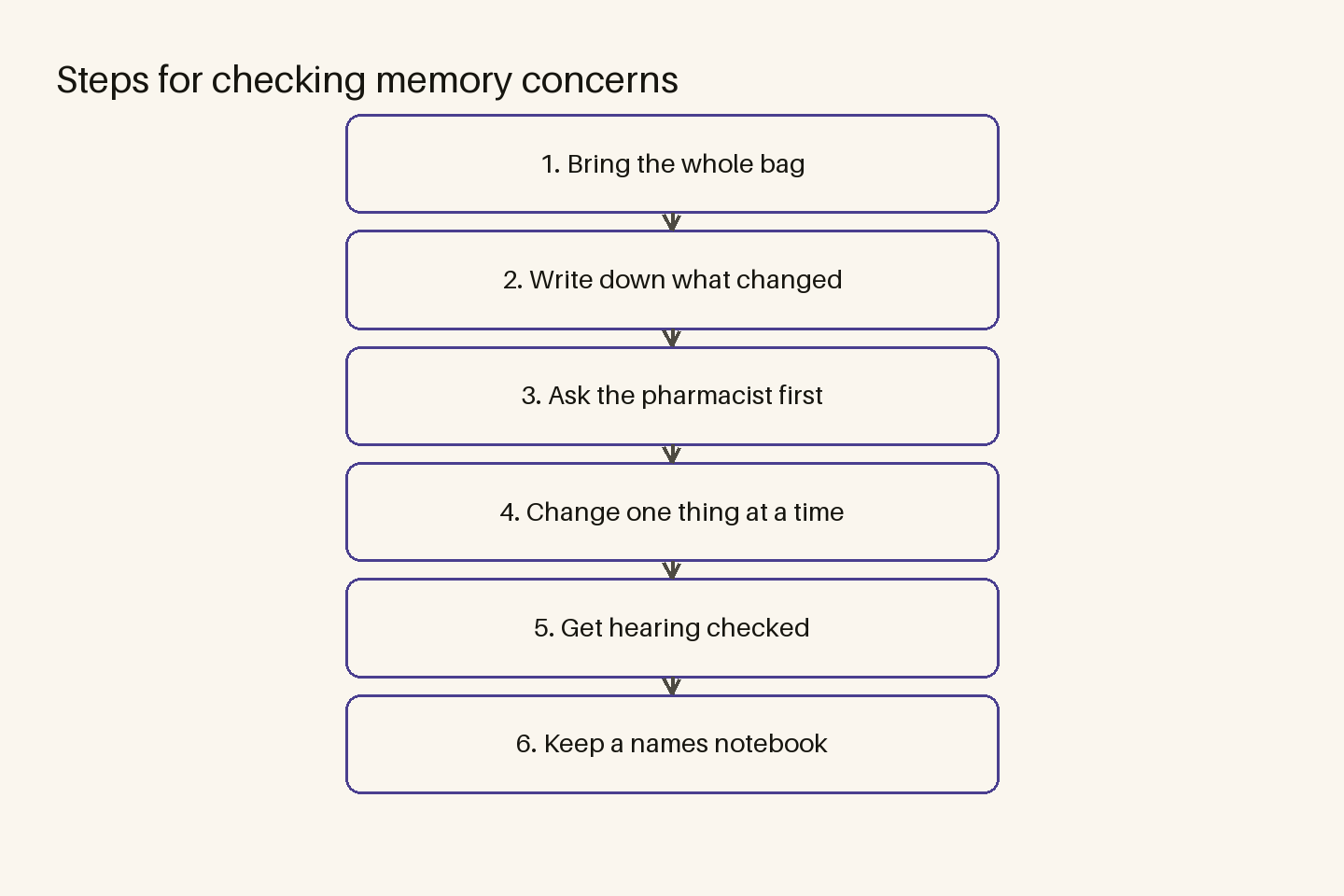
So the steps I actually follow, every Thursday, every kitchen table, are these. Bring the whole bag, bottles and boxes and all. Write down what changed and when, on paper, before the visit. Ask the pharmacist first — she has more time than the doctor. If something changes, change one thing and give it six weeks. Get the hearing checked if anyone in your house says “what” more than you do. And keep a names notebook by the phone, the way I do, because a written name is a saved name, and I say that as a woman who once found her car keys in the refrigerator and has never fully recovered from her husband’s face about it.
I have been at this a long time, and the thing I keep coming back to is how much of what frightens people is a cabinet, or an ear, or a bad night’s sleep stacked on a bad month’s sleep — and how much of the fear itself makes the forgetting worse, because a mind braced for disaster is a poor place to park a name.
 Why memory slips after sixtyThe video explains why memory slips after sixty.
So before you close this page and talk yourself into either panic or denial, open the full video and watch it now, and let it walk you through what I have only pointed at here.
What I still don’t know, after all these years, is why the street name comes back at the sink, why the kettle gets left by the careful ones, why the brain keeps its own counsel about what it holds and what it drops — and I wonder, some Thursdays, packing up the bags, whether anyone will ever really explain that to me.
In this section
Coming next: Checking B12 on Acid Reducers; Too Many Medicines at Once; How to Run a Brown-Bag Review.