I once threw away a woman’s cough syrup because I thought it was past its date. It was not past its date. She had written the year in her own shorthand, and I read it wrong, and I was so sure of myself I tossed the bottle in the bin at the centre before she could stop me. She was kind about it. I bought her a new one and felt foolish for a week. That is the spirit to bring to a brown-bag review. You are not there to be sure. You are there to look.
 Why memory slips after sixtyThe video explains why memory slips after sixty.
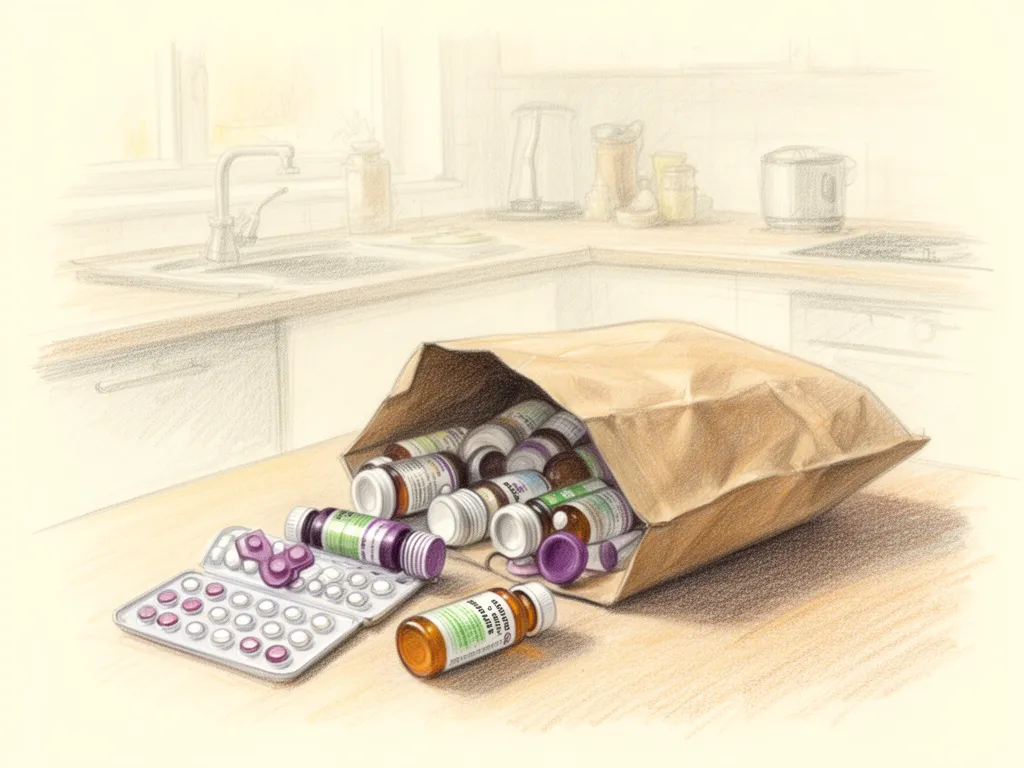
The Brown Bag Itself
Ask them to bring everything. Not just the prescription bottles. The vitamins, the sleep aid from the drugstore shelf, the cream in the bathroom cabinet, the pills in the purse pocket, the ones in the kitchen drawer that rolled behind the foil. People always say, “Oh, I don’t take much.” Then they come in with a bag that clinks. That is fine. That is the point. The bag tells the truth faster than memory does, and memory is the thing we are worried about in the first place. So we do not rely on it. We empty the bag on the table and look.
The Table and the Light
I do mine at the kitchen table on Sunday mornings, next to my pill organiser, where the light is good. At the senior centre on Elm Street I use the table by the window, the one with the wobbly leg, and we sit side by side, not across from each other. Across the table feels like an appointment. Side by side feels like two people doing a chore. That is what it is. A chore, like sorting the change jar. I keep a paper calendar by the phone at home, and I bring a plain notebook to the centre. If a person has their own names notebook or a list someone made for them, that goes on the table too. Everything written down beats everything remembered.
The Questions at the Counter
I go bottle by bottle, one at a time. What is this one for. When did you last take it. Who gave it to you. Does the person who prescribed it know about the others. You would be surprised how often the answer to that last one is no. One doctor does not always know what another started, and the drugstore shelf adds its own quiet pile on top. That tangle is why I named too many medicines at once the first thing to check, and I still believe it. Sometimes the bag holds a sleep aid taken every night for years, or an allergy tablet doing double duty nobody asked for. I do not say it is the cause of anything. I say it is worth a phone call. And if someone has been on a stomach medicine a long time, I mention checking B12 on acid reducers as one more question to carry to the counter, because that one is easy to ask and easy to answer.
A Woman Named Ruth
A woman at the centre, Ruth, sat down with me last spring and said, “My daughter thinks I’m slipping.”
I said, “Let’s look at the bag before we look at you.” She laughed and said it was just pills.
It was not just pills. It was two bottles of the same thing in two different strengths, one from a doctor she no longer saw. She had been taking both. I did not call it anything. I said, “This is worth a phone call, and I would make it today.”
She called her pharmacist that afternoon. The fix was simple. Her daughter called me a month later and said her mother seemed like herself again. I did not do anything clever. I emptied a bag on a table and read the labels. That is the whole trick.
What I Would Tell a Friend
A friend wondering how to do this would get a plain answer from me. “Bring the bag. All of it. Sit somewhere with good light. Write down what you find, because what is written down is remembered. ” That is the heart of it. The medicines and memory at sixty question is usually not a memory question at all. It is a cabinet question. Check the cabinet before you check the person.
I counted it up once, because Walt teased me about running a free clinic out of a tote bag. Here is what I actually spend. The notebooks I hand out: not much a year, really, because I get the small ones and lose a few. The folder with the blank medication lists I photocopy at the library: the copies run me maybe a dime a page, call it a modest yearly outlay. My time: a Tuesday morning. Total, not much more than pocket change a year, imperfect and rounded, and most of that is paper. The cost is not the reason anyone skips this.
Here is the order I keep, the same every time.
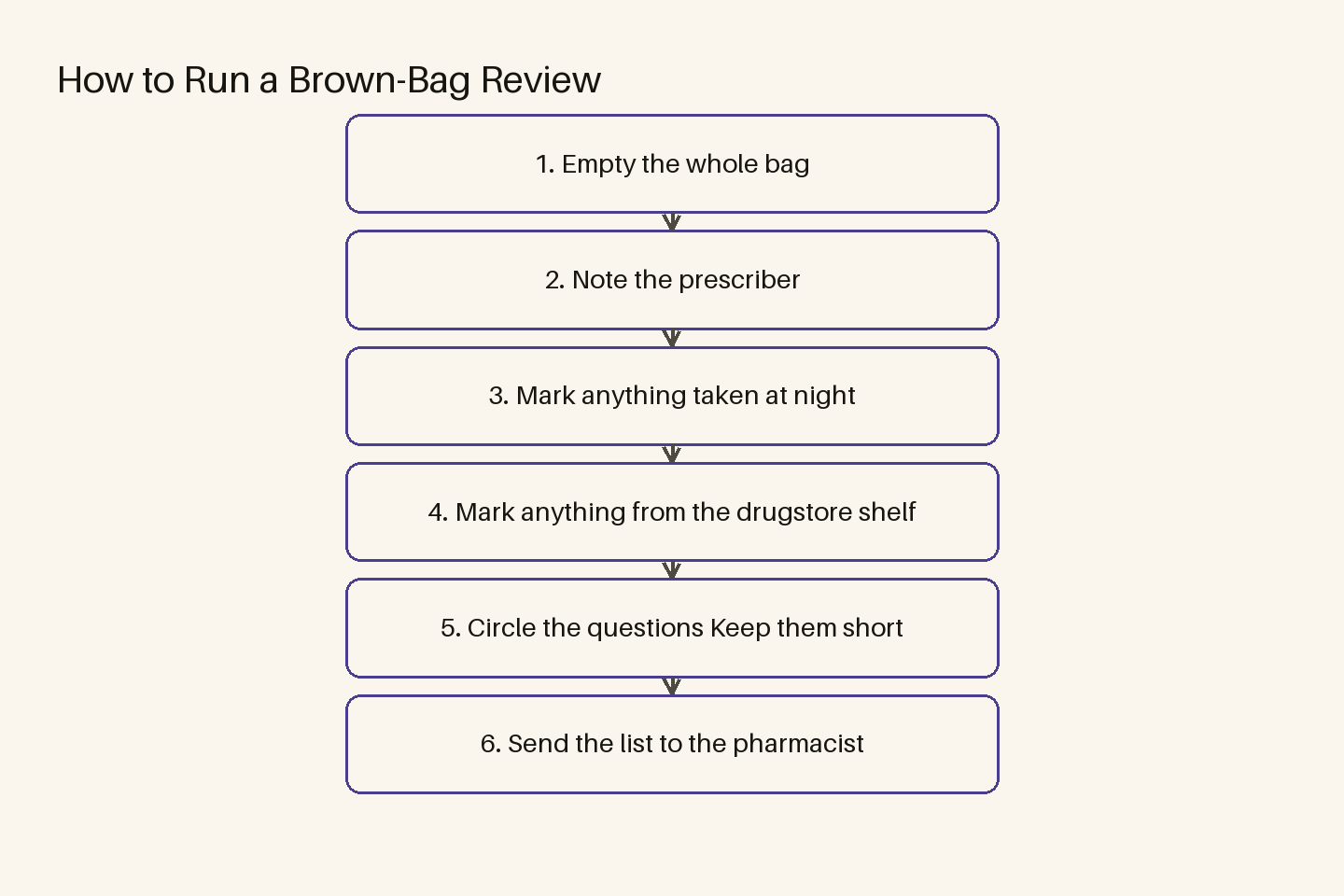
How I go about it, in order
- Empty the whole bag on the table. Every bottle, every box, every tube.
- Write down the name of each thing and what it is for, in the person’s own words.
- Note the prescriber on each prescription bottle.
- Mark anything taken at night.
- Mark anything from the drugstore shelf.
- Circle the questions. Keep them short.
- Send the list to the pharmacist, and to Dr. Okafor if there is a doctor involved.
That is it. Seven steps, none of them hard. The hard part is making the appointment with yourself to actually do it, and I will tell you the same thing I tell everyone who sits at my table: go watch the full video before you put it off another month.