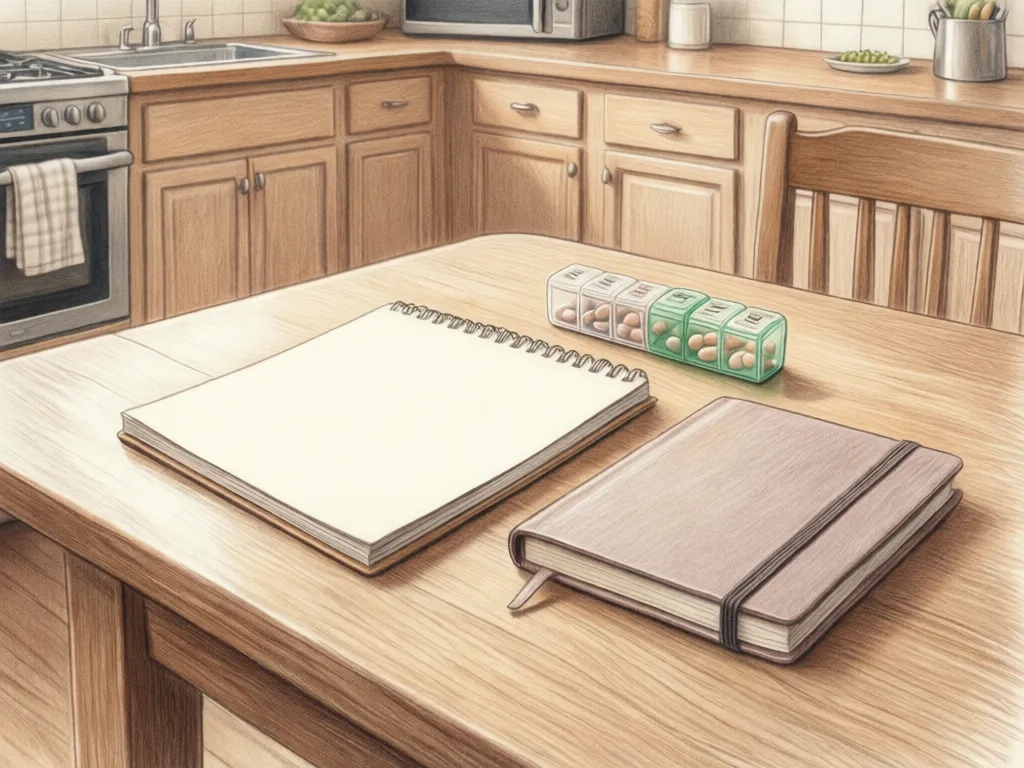
In my own kitchen last Tuesday, I introduced my husband to the woman from the library as “this is — this is — ” and nothing came. Her name is Margaret. I have known her eleven years. She is on my paper calendar twice a month. The name simply stepped out of the room, the way a cat does when company arrives, and it strolled back in at about nine that evening while I was filling the pill organiser for the week. I told my husband. He said, “Write it down before it leaves again.” He was teasing. He was also right. That small hole in the evening is what I want to talk about, because the lapse itself lasted four seconds, and the conversation about it lasted longer, and the second part is the one most families get wrong.
 Why memory slips after sixtyWatch the video: the cause, and what you can do about it.
The Lapse Lasted Four Seconds
The first thing I tell people is to time it before they talk about it. Ordinary forgetting has a shape. It is short. What I saw at the counter all those years was people describing a four-second gap as if it were a four-hour one, because fear stretches time. So when it happens, I note the clock. Not to obsess — to have something true to say when the family asks about it later. “Tuesday, five past six, Margaret’s name, back by nine” is a fact. “My memory is going” is not.
Telling my husband at the Kitchen Table
Then comes the part nobody likes. Saying it out loud. I have sat on the other side of this at the senior centre on Elm Street for four years now, and I can tell you the worst way to hear about a lapse is in front of other people, at a gathering, with a worried face across the table. A man named Harold told me his daughter announced at Sunday dinner, in front of the grandchildren, “Dad forgot my name twice this week.” He had not forgotten her name. He had called her by her sister’s, which is a different thing entirely, and he stopped coming to the centre for a month. I said, “What did you say to her?” He said, “Nothing. I just stopped talking at dinner.” I said, “Then she’ll count the silence too.” He looked at his hands. “I didn’t think of that.”
What I Would Tell a Friend
Asked directly how to raise it, I would give the same advice I give to everyone. Bring it up alone, not at the table. Say what you saw, with the day and the hour, and then stop talking and let them answer. And before anyone worries about anything bigger, ask what is in the medicine cabinet. A kind way to raise memory concerns is worth more than a clever one. If it is your own lapse you are confessing, do it plainly: it happened, here is when, here is what came back. That is the whole speech. After a name forgotten at a wake last spring I wrote mine down in the notebook that same night, and it has never felt like a list of failures. It feels like a record that the names come home.
One Sunday on the Paper Calendar
Let me show you what this looks like with real numbers, because vague worry feeds on vagueness. On Sunday, March 25, I sat down with the paper calendar and the notebook and went back over four weeks. In those 28 days I had written down 11 lapses. Nine were names. Two were why-did-I-come-into-this-room. Every one of the eleven returned within the same day — the longest gap was 6 hours and 20 minutes, and that one I had noted at 7:40 in the morning and recovered at 2 in the afternoon. Zero were whole events. Zero repeated on the same person within the week. That is the shape of ordinary forgetting. If I had instead found the same name lost three days running, or a whole conversation missing, that would be a different shape, and I would be on the phone to Dr. Okafor, who has seen me send her enough people over the years to trust my notes. There is a point where you stop tracking and start asking, and knowing when to call the doctor about memory is easier when you have dates on paper instead of a fog in your chest.
The Myth and the Kitchen Table
The myth is that a family talk about a lapse ends in a diagnosis and a crisis. What actually happens, most of the time, in my kitchen and at the centre, is this: someone says the small true thing, everyone exhales, and the first useful question turns out to be boring. When did you last have your ears checked? What are you taking to sleep? Are you writing it down anywhere? I have watched that conversation go from white knuckles to a grocery list in ten minutes. The talk is not the hard part. The silence before it is.
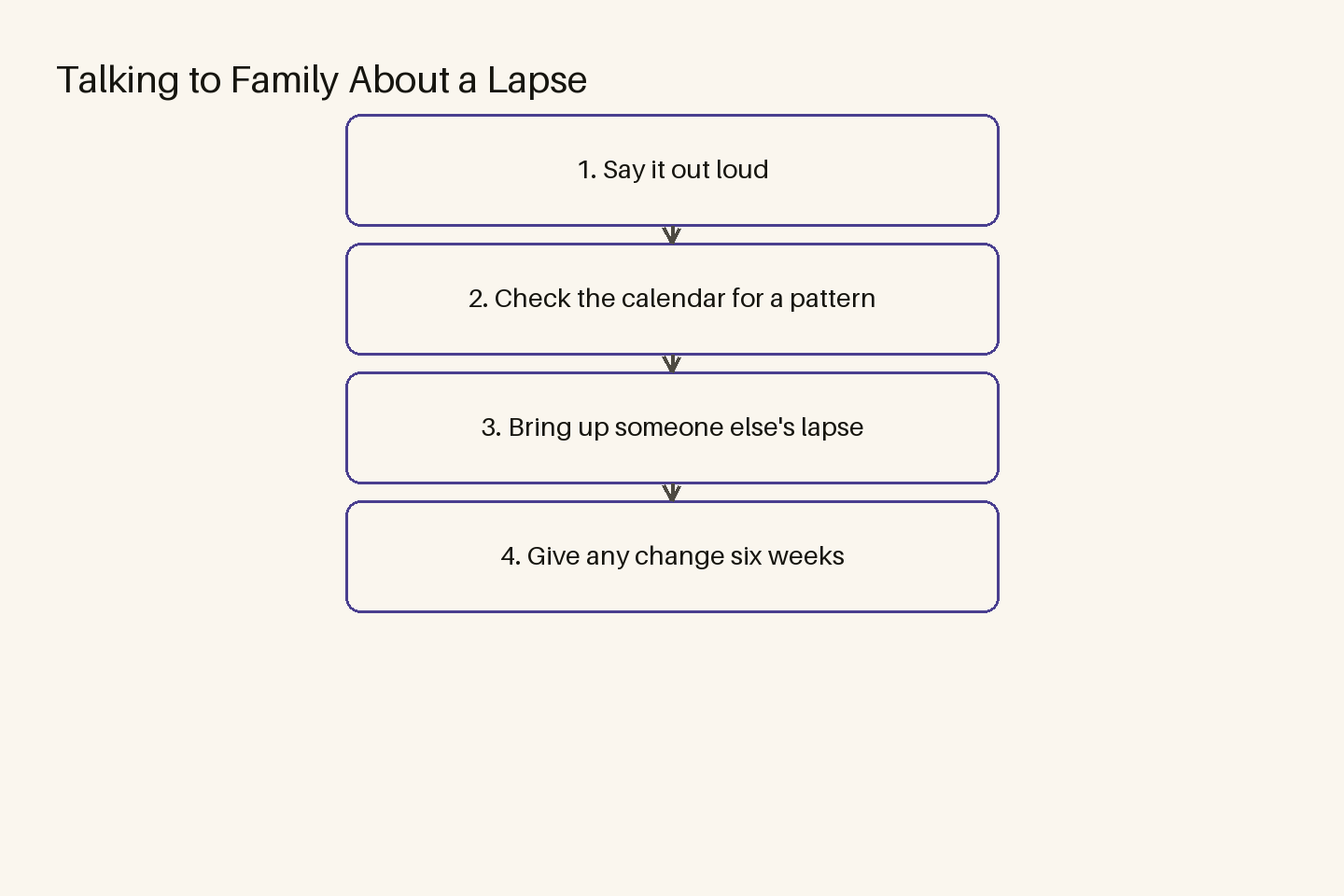
Here is what I do, in order, and it fits on one index card.
How I go about it, in order
- Write the lapse down the same day: date, time, what was lost, when it came back.
- Say it out loud to one person you trust, alone, within the week.
- Check the calendar for a pattern before anyone checks anything else.
- Bring up someone else’s lapse with the day and hour, never in front of an audience.
- Give any change six weeks before you judge it, and change one thing at a time.
There is more behind all of this than fits on an index card, and I would rather you hear the full explanation properly than take my kitchen-table version as the whole of it. Go watch the full video tonight, before another week of wondering goes by.
I still do not know why the name comes back while I am counting out my husband’s Tuesday pills, and not when I am standing in front of the person reaching for it. Nobody I have asked knows either. And I wonder, some evenings, whether Margaret ever stood in her own kitchen and could not come up with mine.