Yes, you can still learn. That is the whole answer, and I will stand behind it at the pharmacy counter and at the senior centre both. The brain at sixty-five or seventy-five is not the brain at twenty-five, but it has not closed up shop. It has simply changed how it likes to work.
What I saw at the counter, over thirty-two years, was this: the people who stayed sharp were rarely the ones doing puzzles alone in a corner. They were the ones who had taken up something with their hands, or something with other people, and kept at it badly for a long while before they got good.
Learning Without Knowing You Are
There is a kind of learning that does not feel like learning at all. A psychologist spent his working life on it. He was born in Philadelphia in 1940, took his doctorate at Brown in 1967, taught for decades at Brooklyn College, and died just this past September at eighty-five. His big idea had a dry name — implicit learning — but the notion underneath it was plain. We pick up patterns without being able to say what they are. A child learns to speak before anyone teaches her a rule of grammar. That same quiet machinery keeps working long after the hair goes grey.
Reber wrote it up in 1993 in a book on what he called the cognitive unconscious, and the work reached into everything from language to sport to aging itself. I take comfort in that. It means you do not have to feel yourself studying in order to be learning. You only have to keep showing up to the thing.
Some researchers who came after him, people like David Shanks and Lee Brooks, argued that what we absorb this way is not rules at all but fragments — little concrete instances, one at a time, like buttons dropped in a jar. That matches my own experience. When I was learning the names notebook habit, it was not a system that saved me. It was one written name, then another, then another. If you are picking out something new to learn, pick something made of small repeated pieces. That is the shape your older brain likes best.
Six Months at the Watercolour Table
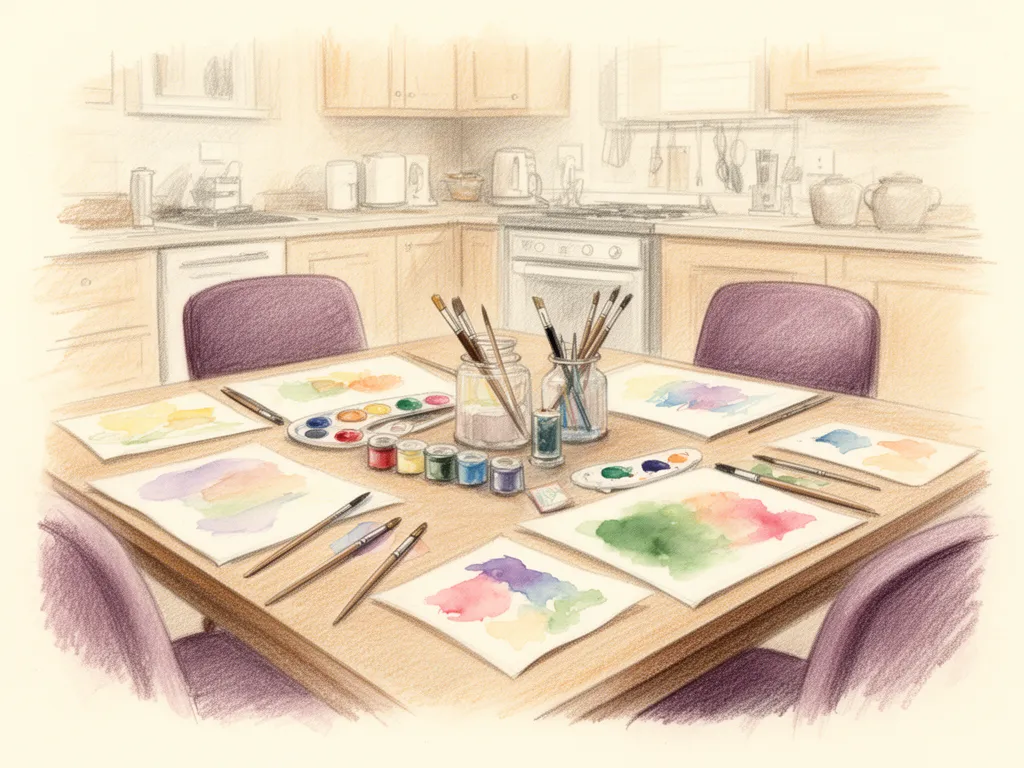
Let me give you a real example, with the numbers in it, because my husband says I deal too much in generalities. A handful of people signed up. By the end of February we were down to a handful, which is about what I expected — the first month is where good intentions go to be tested. Those who stayed met every Tuesday for what felt like ninety minutes. Nobody was asked to be good. They were only asked to come back.
By June, several of them told me, each one separately and without my asking, that they had started remembering to bring things from home — a photograph to work from, a particular brush. That sounds like nothing. It is not nothing. Remembering to carry an object across town on the right morning is exactly the sort of errand people come to me worried about. I am not saying paint changed anything. I would never say that. I am saying that a standing Tuesday appointment with a reason attached to it gave memory a job to do, and memory, like most of us, works better with a job.
The cost was modest. The centre supplied the paper and the paints from its own budget, and nobody was asked to bring money at all. One change, kept up for six months, judged at the end of it. That has always been my rule, and it holds here. If you want the wider frame for this, the habits that hold memory and clarity are mostly this same rule wearing different coats.
Now, before you set this note aside and forget it — and I say that kindly, as someone who once found her reading glasses in the silverware drawer — pull up watch the explainer on memory slips video on what is usually behind memory slips after sixty and what to do about it. Watch it all the way through, with a pencil in your hand.
Here is what I actually do myself, and have done for years. I write the new thing on the paper calendar by the phone, in ink, on a fixed day. I keep it small enough that I cannot fail at it in the first six weeks — fifteen minutes counts. I do it in company when I can, because other people are the best reminder system ever built. I do not add a second new thing until the first one has held for six weeks. And I write down what happened, because what is written down is remembered.
 Why memory slips after sixtyThe video explains the cause, and a way to steady your memory.
If you are ready to go further, open watch the long-form memory slip explainer video now and follow it from the beginning. It will walk you through what I cannot fit on one page.
Tonight, or tomorrow at the latest, put one line on your calendar. Just the name of the thing you mean to learn, and the day. Ink, not pencil.