Tuesday morning, ten past nine, and a friend from the walking group had her coat on the back of her chair at the senior centre on Elm Street, her handbag open on the table, and a pair of reading glasses in her hand that she was not wearing. She said she had come for the brown-bag review but she could not find her drops. She had them, it turned out. They were in the side pocket. She laughed about it, and then she did not laugh, and she said the thing people say to me now more than they used to, which is that her memory is going.
I asked her when she had last had her eyes looked at. She said her eyes were fine. She could read the menu board at the coffee place if she stood close enough. That is not the same thing as fine, and I said so, gently, because a friend from the walking group runs the walking group and is not used to being told anything.
What I see, four years into these Tuesday mornings, is how often the word memory turns out to be the word seeing wearing a coat. Then you stop going to the Tuesday thing because it ends at dusk. Then you miss the names, because you cannot quite read the face across the table, and faces are how most of us keep names. The forgetting has a shape. It has a reason. It just is not the reason people fear.
The Coat over the Lamp
I think of a cataract like a coat hung over a lamp. The bulb is fine. The room is the same room. But everything in it goes soft and shadowed, and you start to think the room has changed. People squint through a cloudy lens for years and never say so, because it happened a degree at a time and they adjusted, the way you adjust the chair that has always wobbled.
My sister Carol calls from Arizona with her worries, and last winter the worry was that she could not remember the plot of the book she was reading. I asked her one question: was she reading with the lamp on her left, where it has been for twenty years, or had she moved it. Long pause. She had moved it closer, and then closer still, and the print still went grey on her by nine o’clock at night. She was not losing the plot of the book. She was losing the page. She had thought it was cream for years. She had forgotten that white was white.
That is the part I want to put plainly. When sight fades, the world hands you less to remember. You cannot recall what never got in. But eyes are the quietest of the three. A person will complain about their ears before they will complain about a cataract, and half the time the family notices the memory before anyone notices the squint.
The Squint Nobody Mentions
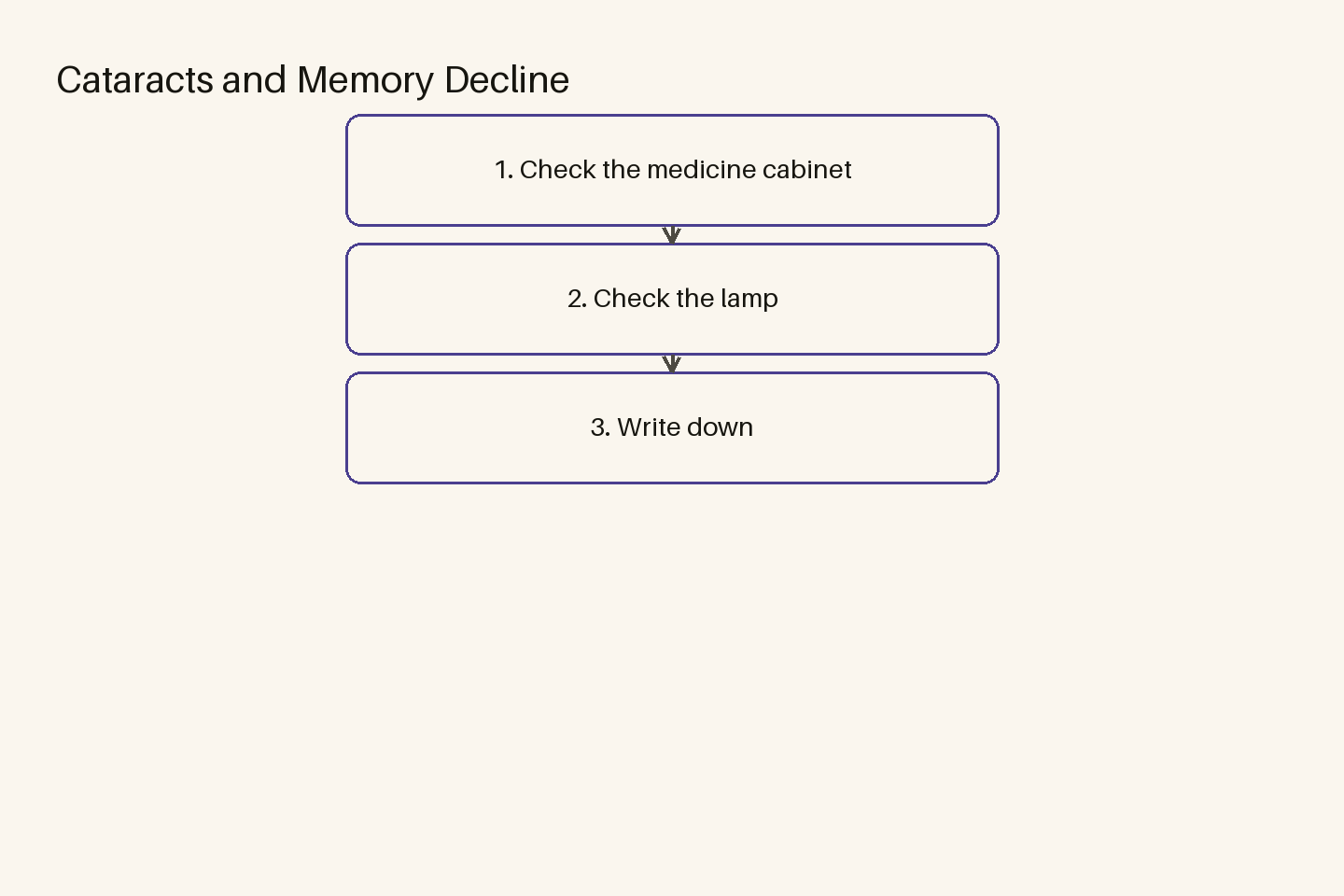
At the pharmacy counter in the basement of the hospital, thirty-two years, I watched people lean in to read their own bottles. I watched them bring the label to the light by the window. We talked about the pills. We rarely talked about the leaning. Now, on the other side of retirement, I watch the same leaning at the senior centre and I have learned to ask about it before I ask about anything else. Check the medicine cabinet before you suspect dementia, I have said for years, and I still say it. But I have added a step. Check the lamp, the glasses, the last eye appointment. Check whether the person has quietly stopped driving at night.
The country has been having its own version of this conversation, loudly, for years. Since the early days of the 2016 campaign, a president’s physical and mental sharpness has been argued over in public — a man who was 70 when he first took office, older than Reagan had been, who at 80 became the oldest person in American history to assume the presidency at his second inauguration in 2025, and whose campaign would not release basic medical records for a long stretch, the most recent full release dating to 2015. By May 2026, multiple polls showed most Americans did not believe he was mentally fit for the job. I take no side in that argument from my kitchen table. But I notice what the argument is made of. It is made of appearances on screens, of pauses, of whether a man seemed to doze in a meeting. It is made of what people could see and hear at a distance, filtered through cameras and rooms. And I think: if a whole country cannot agree on what it is seeing in one man it watches every day, how sure is any family about what it is seeing across one dinner table. Get close first. Get the eyes looked at. Then talk.
A friend from the walking group, in the end, did the arithmetic herself, because I asked her to. Here is what it cost her, rounded, because that is how real numbers come. She wrote it all in the small notebook she keeps in her handbag, because I told her that what is written down is remembered, and she likes proving me right.
Here is the worked example, because one real story is worth a dozen generalities. A man in the walking group — I will not name him, but a friend from the walking group will know — missed three Tuesdays in a row last October. Missed, as in did not come, and when he came back he had lost the thread of things. Could not recall who had walked with whom, could not place a new member’s name though she had introduced herself twice. His daughter was making quiet phone calls. What had actually happened: his cataract had thickened over the summer, night driving had gone from uncomfortable to impossible by the time the clocks changed that autumn, and the Tuesday group ends at half past five, which in late October here is already dark. He was not forgetting the group. He could no longer get himself to it, and he was too proud to say so, so he said he had been busy. By the April walking schedule he was back, and the new member’s name came to him on the second Tuesday, because he could finally see her face when she said it.
Not every version goes that smoothly, and I will tell you about the one that did not, because it cost something. A woman at the centre — this was two years ago — had her first eye done and it went well, and she was so pleased with the brightness that she did not go back for the second eye. Not because of money. Because the first result felt like enough, and the follow-up appointment meant a ride she did not want to ask for, and one thing slid into another. Eleven months passed. Nothing broken, but a bad sprain, six weeks off her feet, the walking group gone for a season, and her confidence gone longer than her ankle took to heal. The second eye got done in the end, a year late. What it cost her was not a bill I can add up. It cost her a winter of being afraid on her own stairs, and that is the most expensive kind of cost there is at our age, because it does not come back when the ankle does.
I have a small sign taped inside my own cupboard door at home, near where the pill organiser sits on Sunday mornings waiting to be filled. It says: lamp, ears, cabinet, calendar. In that order. Lamp first, because light is the cheapest fix and, in my experience, the most neglected. Before you decide anything about your memory — before you decide anything about your mother’s memory, or your husband’s — sit with the lamp question for a week. Can she read the post at the table where she has always read the post. Does he hold the paper further away than he did at Christmas. Has anyone stopped driving after dark and called it preference.
 How to keep your memory steadyA plain video on why memory gets patchy after sixty.
And before you change any of it — before you book the appointment, before you raise it at Sunday dinner, before you move a single lamp in the house — go watch the memory slip deep dive video first, and then decide what your week of noticing needs to look like. It will show you what is usually behind the slips, and it will keep you from fixing the wrong thing with great confidence, which is the mistake I see most.
One thing, before I put the kettle on. This week, on one ordinary evening, sit in the room where the reading happens at the hour the reading happens, and look at the page from the chair that is actually used. Not your chair. Theirs. Write down, in whatever notebook is nearest, what you can and cannot read from that seat. That is the whole task. It takes four minutes. The calendar by the phone can hold the rest.