Margaret held the little spiral pad up like it was evidence in a trial. It was the size of a playing card, bent at the corners, and the elastic band had gone grey. “This thing runs my life,” she said, and then she laughed, because she had come to the senior centre on Elm Street that morning to ask me whether forgetting her neighbour’s name meant what she was afraid it meant.
I asked her when she had started carrying it. She said about a year ago, when the forgetting started to bother her. I told her that was the wrong way round to think about it.
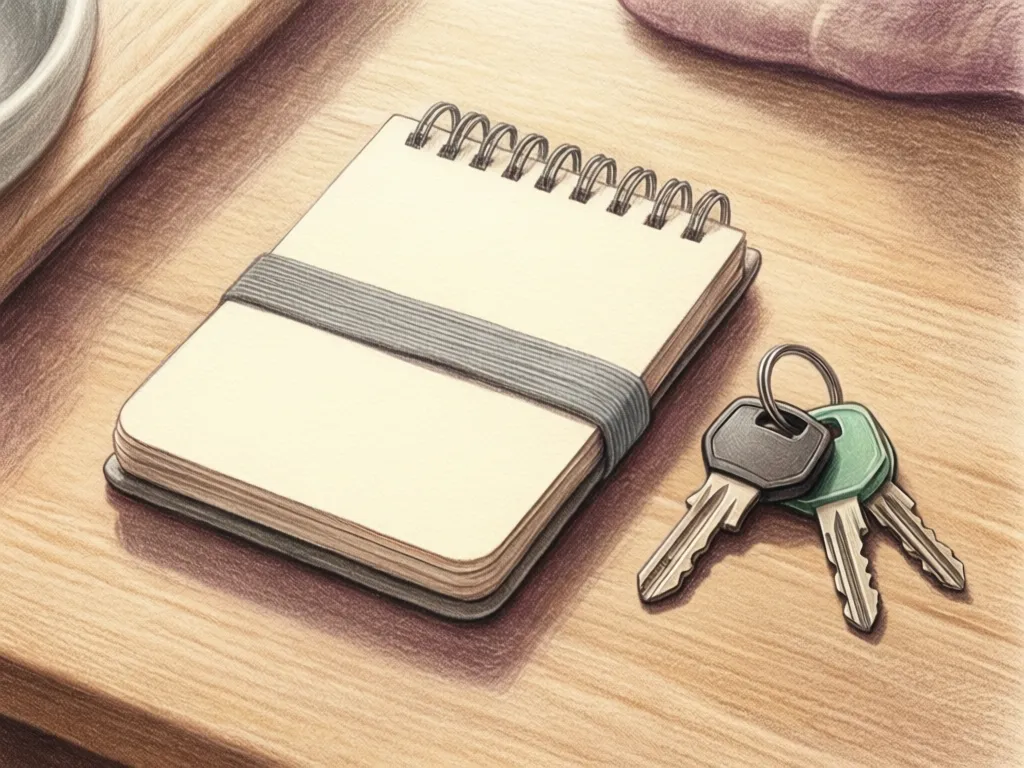
A pad with a grey elastic band
Margaret’s pad had everything in it. A granddaughter’s new phone number. The name of the man who fixed her gutter, with the date. “Library book due back Tuesday” written twice, because she did not trust the first writing. The pad was not a sign her memory was failing. It was her memory, doing its job on paper instead of in her head.
I have kept a names notebook for years, ever since I stood in the grocery store one Saturday and could not produce the name of a woman I had filled prescriptions for a hundred times. It came back at midnight, which is exactly when you do not need it. Now I write names down. The notebook remembers. I get the credit.
People have done this for a long time. By the fifth century BC, long texts were being committed to scrolls, some running to 60 feet. Somebody decided it was better to know where a thing was written than to carry every word around in the skull. That is not decline. That is good sense, and it is older than all of us.
The page where names go to wait
Here is the myth I hear at the centre, word for word: “If I write it down, my brain will get lazy.” What actually happens is the opposite. Margaret’s pad did not make her memory lazy. It made her memory calm. She stopped spending the whole day rehearsing the gutter man’s name so she would not lose it, and once she stopped rehearsing, she could think about other things.
There is a piece of research I keep in mind. Daniel Wegner at Harvard wrote about what people now call the Google effect in July 2011, after a series of experiments with Betsy Sparrow and Jenny Liu. The finding, in plain words: when we know information is stored somewhere we can reach, we remember where it is kept rather than the thing itself. People read that as a warning. I read it as a description of a very old trick. By January 1980, interview studies were already describing erudition shifting from holding everything inside to knowing how and where to find it. The knowing-where is the skill. The pad is the place.
I will say the thing that went wrong, because it cost me. Years ago, before the notebook habit, I told a man at the pharmacy counter I would remember to ask the doctor about his cough syrup question. I wrote nothing. I remembered at nine that night, at home, with no way to reach him. He came back two days later, polite about it, and I was not polite about myself. A pharmacist’s whole trade is that nothing rides on memory alone. I knew better. That is what it cost: a man waited two extra days with a question that mattered to him, because I trusted my head to do paper’s job.
 How to keep your memory steadyThe video walks through the common cause of forgetting after sixty.
Before you change anything about how you track your own days, go watch the video explanation so you can see what is usually behind the slips and what actually helps.
Ink on paper beats good intentions
The exchange I remember best went like this, at the centre last spring. A woman named Doris said, “I don’t need a notebook, I have a good memory.” I said, “So did I, and it kept me humble.” She said, “What do you write in it?” I said, “Everything I would hate to lose.” She got one the next week. A month later she told me the notebook was the best thing she had done all year, and she said it a little resentfully, the way you do when you were sure you were right.
These are real numbers. In that January 1980 work I mentioned, there were two interview studies, 30 people each — 30 university students in one, 15 men and 15 women, and 30 adult women in the other. Sixty people, all asked about how they remember, and the picture that came out was not brains failing. It was people leaning on lists, notes, calendars, other people. Wegner had a name for that earlier: transactive memory. I know the walking schedule because Bev, who runs the walking group at the senior centre, knows it, and she knows I keep the medication questions. Nobody calls that cheating. That is a division of labour, and families have run on it since there were families.
My own steps are plain. I keep the paper calendar by the phone, and anything with a date goes on it the moment I hear it. Names go in the names notebook with one detail — “Rose, red scarf, daughter in Denver” — because the detail is what pulls the name back. The pill organiser gets filled Sunday mornings at the kitchen table, not from memory but from the bottles. And once a week I read the notebook back over, the way you check the doors before bed. Walter Ong, a priest and English professor who spent his life on this, found that people remember best what is rhythmic and repeated. A weekly read-through is my rhythm. You do not need mine — you need one.
This is not the only tool worth having. Names have their own small system, and the rest of the everyday memory tools after sixty sit alongside it — hearing checks, the calendar, the brown bag. The notebook is just the one that fits in a pocket and never needs charging.
Now that the pad and the problem are both on the table, sit through the video walkthrough before you decide your memory is the thing that needs fixing.
Tonight, before bed, write one thing down — a name, a date, the thing you keep meaning to remember — and put the pad where your keys go.