I have a confession to start, because I believe in beginning honest. Last March I stood in my own kitchen with the blood-pressure cuff in my hand and could not remember where the hall drawer was. My own hall. My own drawer. I had put the cuff away in that drawer for four years. Walt watched me open the broom closet twice and said, “You want me to draw you a map?” I said no thank you. I found it on the third try, right where it always was, and I sat down at the kitchen table and laughed, and then I wrote the whole thing down in the names notebook, because writing it down is what I do. That is the whole of this note, really. The tools are not complicated. The complicated part is admitting you need them.
The paper calendar by the phone
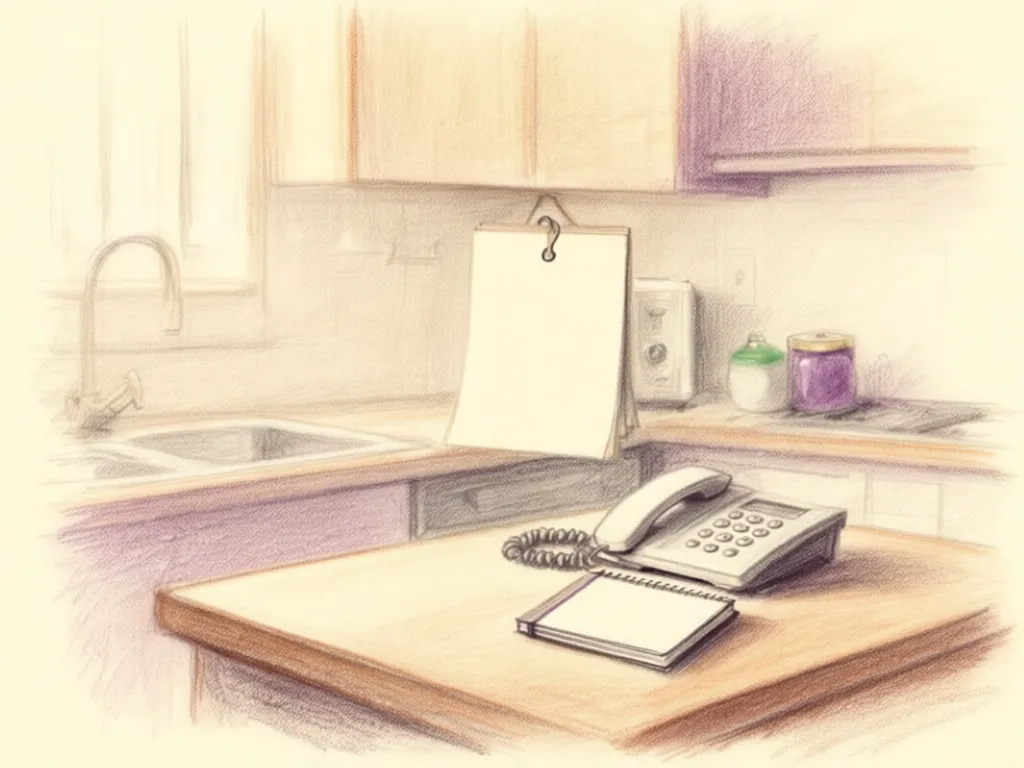
I want to tell you about the calendar first, because it is the oldest tool I own and the one people argue with me about. Mine hangs by the telephone. It is paper. It has squares big enough to write in, and I write in them. Carol calls from Arizona and says, just put it in your phone, Diane, the phone reminds you. I know the phone reminds you. I have watched people at the senior centre on Elm Street get reminded by their phones and swipe the reminder away while they are mid-sentence with me, and the reminder is gone, and so is the appointment. A swipe takes half a second and leaves nothing behind. A paper square on a wall takes up room in your house and in your eye, and it does not go anywhere when you look away from it.
There is a second thing the paper calendar does that the phone does not, and it is the thing I care about most. It lets you see the shape of your week. When someone at the brown-bag table tells me they feel foggy, I ask them what their week looks like, and they almost never know. Not because they are losing anything. Because the week lives in a pocket and only comes out one day at a time. On my wall I can see that Tuesday has the walking group and Thursday has nothing and Friday has too much. The National Institute on Aging has a plain way of putting the difference between ordinary forgetting and the kind worth a doctor’s visit, and a lot of it comes down to exactly this — whether you can still hold the shape of your days. The NIA describes ordinary forgetting at sixty as misplacing the glasses and finding them, not forgetting what the glasses are for. A calendar on the wall is how you keep proving that to yourself, one square at a time.
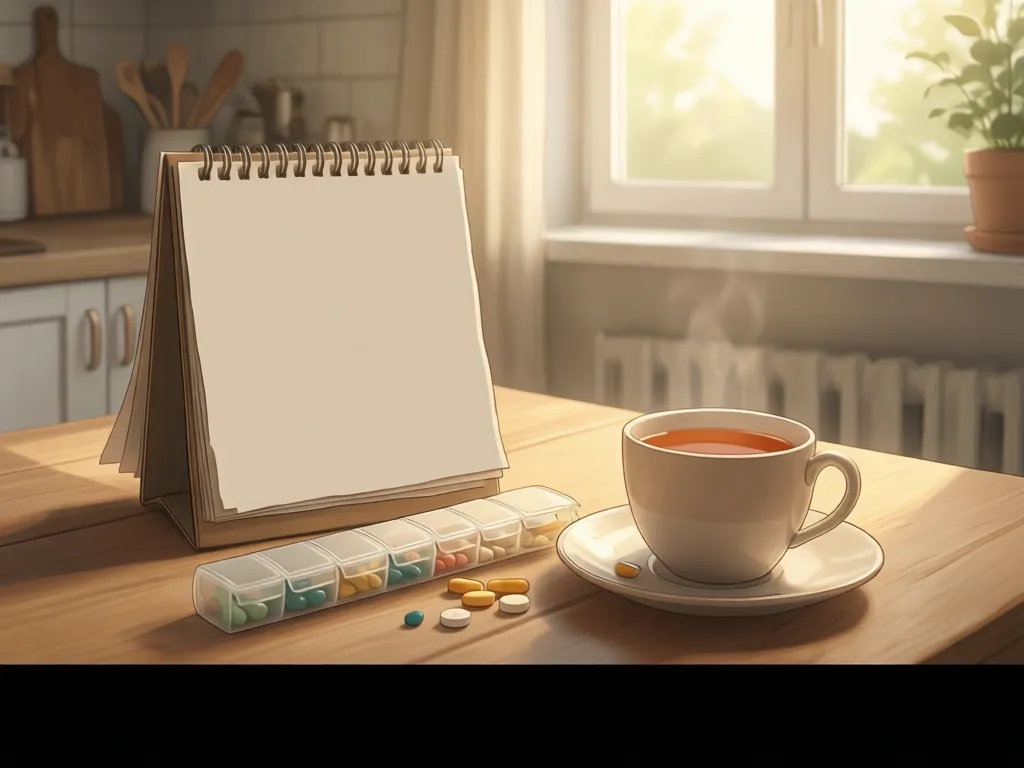
I fill mine in on Sunday mornings, same morning I fill the pill organiser. The two sit next to each other on the kitchen table and the whole ritual takes about twenty minutes with coffee. Walt reads the paper. I write the week. It is the least technological thing in our house and I would give up the microwave before I gave it up.
The notebook with names in it
The second tool is the names notebook, and I have written about pieces of this before, but not the whole habit. It is a small notebook. It lives by the calendar. When I meet someone new at the centre, I write their name and one true thing about them. Not their medical history. One true thing. Marjorie, the one with the roses. Tom, asks about Walt’s lathe. That is the entire system.
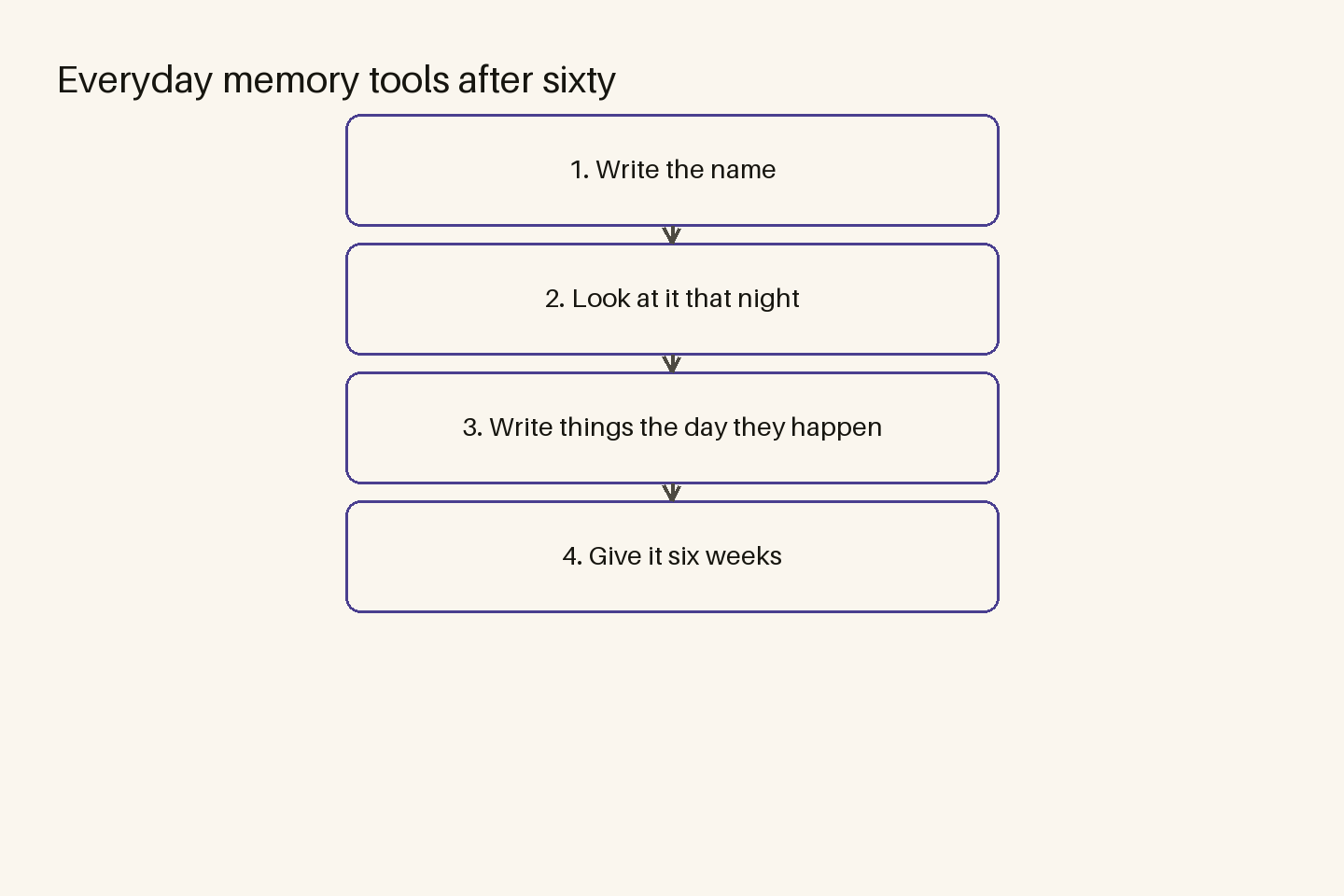
People are embarrassed by this. They think needing to write a name down means something is wrong. I spent thirty-two years in a basement pharmacy learning the names of drugs that were deliberately named to sound like each other, and I wrote those down too, every day, because that is what careful people do with names. Names were slippery at thirty. They are slippery at sixty-four. The difference is that at sixty-four we have decided it means something terrible, and so we hide the slip instead of catching it. Write the name. Say it back to the person once. Look at it that night. I have been doing it since before Walt retired and my recall for new names is better now than it was in my fifties, for one boring reason — I have a system and I use it without shame.
Here is what I would tell you if you asked me over the fence. Get one calendar, paper, hang it where you stand every day. Get one notebook, small, keep it in one place. Write things the day they happen, not the day after. Do not get anything special. Do not download anything. Give it six weeks before you judge it, because one change needs six weeks to show you what it does. That is the whole prescription, and I am not even prescribing it, I am just telling you what sits on my table.
Now, the argument I hear back, and I hear it every week, is this one: isn’t all this writing things down just a crutch? Doesn’t leaning on paper make your memory lazier? And I will meet that argument halfway, because there is something true in it. If you never try to recall anything, if the notebook becomes a place you dump information and never revisit, then yes, you have built a filing cabinet, not a memory. I have watched it happen. A woman at the centre kept a beautiful notebook, everything in it, and she never once looked back at a page. The notebook remembered. She did not.
But here is where I push back, and I push back from the pharmacy counter, not from theory. The writing is not the remembering. The writing is the first rehearsal. You write the name, you read it back that evening, you say it to yourself the next morning — that is three times your mind has held the thing, and by the third time it is usually yours. The paper is not the crutch. The paper is the practice field. And I will say the harder thing too: the people who refuse the notebook on principle are not training their memory either. They are just losing names quietly and calling it principle. Pride is not a memory strategy. It is the thing that keeps people from having one.
Watch the video before you rearrange a single thing in your house.
I will tell you a small thing about my mother’s house, since sold, because it loops back. My mother kept everything in her head and was proud of it. Telephone numbers, birthdays, the exact shelf where the good scissors lived. When I was home from college I watched her open a drawer for the scissors, find them, and then stand there a moment too long, and I understood she had forgotten which drawer and checked three. She never wrote a thing down in her life. She thought writing it down was the beginning of the end. I thought about her last March, in front of my own broom closet, cuff in hand. The difference between us is not our memory. It is that I gave myself permission to have tools, and she never did. I sold that house with the scissors still in the wrong drawer, is what I am saying. The tools are not the decline. Sometimes the refusal is.
Now the cost of all this, because I actually sat down and figured it once, when Carol accused me of running a stationery store out of my kitchen. The paper calendar runs me about the cost of a sandwich a year, the kind from the drugstore with the big squares. The notebook is maybe the cost of a coffee and lasts me most of a year — call it a bit more to be safe. The pill organiser I have had so long I cannot honestly tell you what it cost, but a plain one runs about what two coffees run. Pen, I will say a dollar, though Walt would tell you I steal his. Total for the year: around the cost of a couple of lunches, give or take the coffee I drink while doing the Sunday filling. I checked my arithmetic twice and it still came out cheaper than one co-pay on the wrong test, which is the comparison I care about.
Let me give you one worked example, real numbers, from this spring. On April 14th I wrote in the notebook: my friend from the walking group’s walking group moves to 9 a.m. starting the 21st. On April 21st at 8:40 I looked at the calendar square — walking group, 9:00 — and I was on Elm Street by 8:55. The old time would have had me there an hour early, standing in the cold, telling myself I was losing it because I “couldn’t keep a simple time straight.” That is the whole example. One line in a notebook, one square on a calendar, and a Tuesday that stayed ordinary instead of turning into evidence against me. Multiply that by fifty-two weeks and you see why I am stubborn about paper.
My steps, plain as I can make them. Sunday morning: fill the organiser, write the week on the calendar, read back the week’s new names from the notebook. Each evening: glance at tomorrow’s square. When a name slips: write it, say it, look at it once more before bed. When something feels off for more than a few weeks: the brown bag goes to the pharmacist first, and if the bag is clean, Dr. A doctor I trust gets a call. In that order. Always in that order.
 How to keep your memory steadyWatch the video: what is usually behind the slips, and a way to improve it.
Sit through the video before you change any of it.
What I still don’t know, and I will leave it hanging because it hangs in my own kitchen: my mother never wrote anything down, and I write everything down, and I do not know whether she would have kept more of her days, or just had better documentation of losing them. The notebook can’t answer that. Nothing can. I write anyway.
In this section
Coming next: The notebook as an external memory; Remembering names with a simple system; Setting up a phone for older hands.