Last Tuesday I stood in the hallway with my reading glasses in my hand, looking for my reading glasses. Walt found them. He said nothing, which is worse than saying something. He just handed me a grape from the bowl on the counter and went back to his chair.
 Why memory slips after sixtyThe video explains why memory slips after sixty.
I am sixty-four. I have filled my pill organiser on Sunday mornings for years, kept a paper calendar by the phone since before the children left, and I still lose a name mid-sentence the way a radio loses a station. So when someone at the senior centre on Elm Street leans across the table and whispers that their memory is going, I do not pat their hand. I ask them to tell me what they forgot, and when, and what else was going on that week. Ordinary forgetting has a shape. So does the other kind. The shapes are different, and learning the difference is most of the battle.
The name that will not come
The commonest slip I hear about is the name. You see the woman from church in the cereal aisle, you know her daughter’s wedding was in June, you know she takes the water pill because she told you so in the car park, and her name is simply gone. It sits just out of reach like a word in a dream. Then at nine that night, washing up, it walks in the back door. Marjorie.
That delay is the signature of ordinary forgetting. The name was filed. The filing clerk was slow. At the pharmacy counter in the hospital basement I used to watch young pharmacists do it too, standing in front of the shelves, snapping their fingers. Their clerk was faster, that is all. Mine takes a lunch break now.
A slow clerk is not a missing clerk. What I watch for, in myself and in the people who come to the brown-bag reviews, is whether the thing arrives later, or whether it was never there at all. Forgetting the name and finding it at nine o’clock is one thing. Meeting Marjorie and not remembering that you have met her before, ever, is another. The first is a retrieval problem. The second is a storage problem, and it deserves a conversation with a doctor, not fear, just a conversation. Dr. A doctor I trust, who I send people to, puts it plainly: worry about the second kind, not the first.
Where the glasses went
The second slip is the object. Glasses, keys, the letter you were going to post. Here is what I have learned about my own keys, and I learned it the hard way, by finding them in the fridge on top of the butter. The keys go missing when my hands did a job my mind never attended. I came in with the groceries, thinking about whether Carol had taken her new tablet that morning, and my hands put the keys where hands put things when nobody is supervising.
That is not memory failing. That is attention never showing up to the job in the first place. You cannot retrieve a note that was never written down. I tell the walking group this and a friend from the walking group laughs, because she does the same thing with her gloves.
The fix is not a sharper brain. It is a slower doorway. I put things down out loud now. It feels foolish. It works, because saying it makes a note where there was none.
The six weeks I gave it
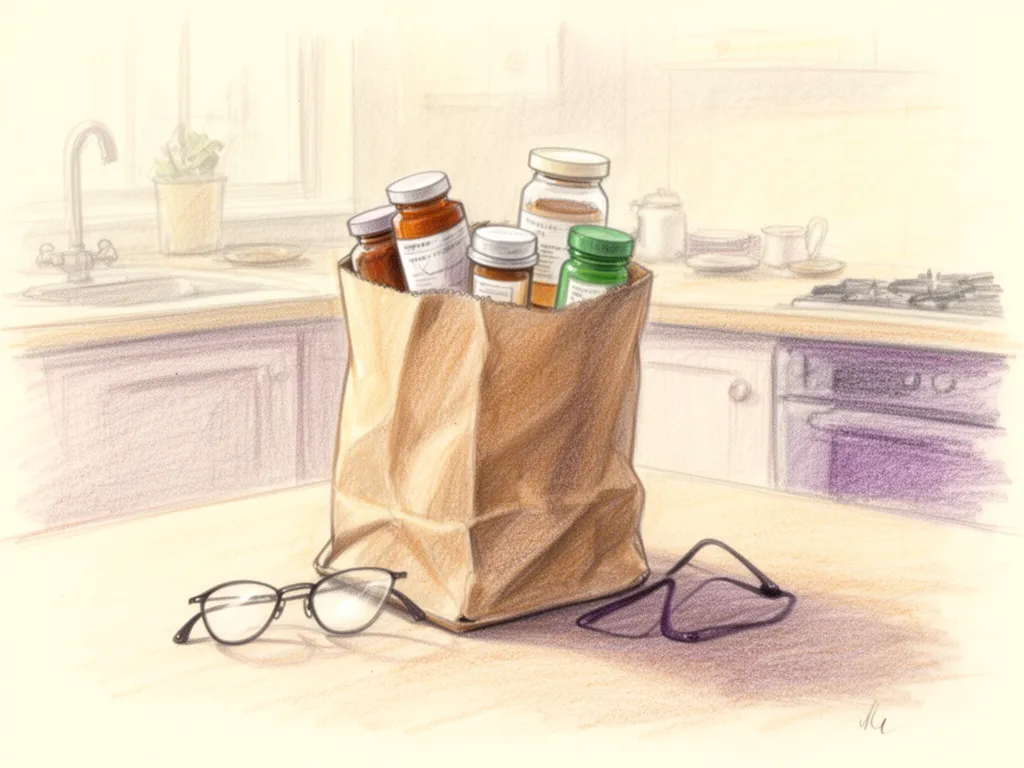
The third slip is the fog, the feeling that the whole machine is running rough. And here is where thirty-two years behind a pharmacy counter shaped everything I think. Before I let anyone, including myself, blame age for a foggy month, I want the medicine cabinet looked at. Every bottle, every box, the drugstore shelf too, into a brown paper bag and onto the table. I have watched a fog lift off a person like weather when the bag got sorted and one thing was changed with their doctor’s say-so.
The same goes for the ears, and I will say it plainly because I did not believe it at first: hearing is memory. If you did not catch what was said, you will not remember it, and you will blame your mind for what your ears did. Carol fought me on her hearing check for a year. Then she had it, and now she finishes my sentences for me, which I did not miss as much as I thought.
Now, the pushback I always get, and it is fair. Someone says: Diane, you are telling me it is nothing, but what if it is something? My mother repeated herself for two years before anyone took it seriously. I hear this at every brown-bag table, and I partly accept it. I do not believe in being soothed. The shape test cuts both ways. If a thing repeats within the hour and the person does not know they already said it, that is not the slow clerk. That is the note that never got written, and it deserves the doctor. What I push back on is the leap from a lost name to a lost future, with no look at the medicine bag, no hearing check, no sleep, no thought to what grief or loneliness is doing to a person’s attention. Check the easy things first. They are easy to change, and they are common.
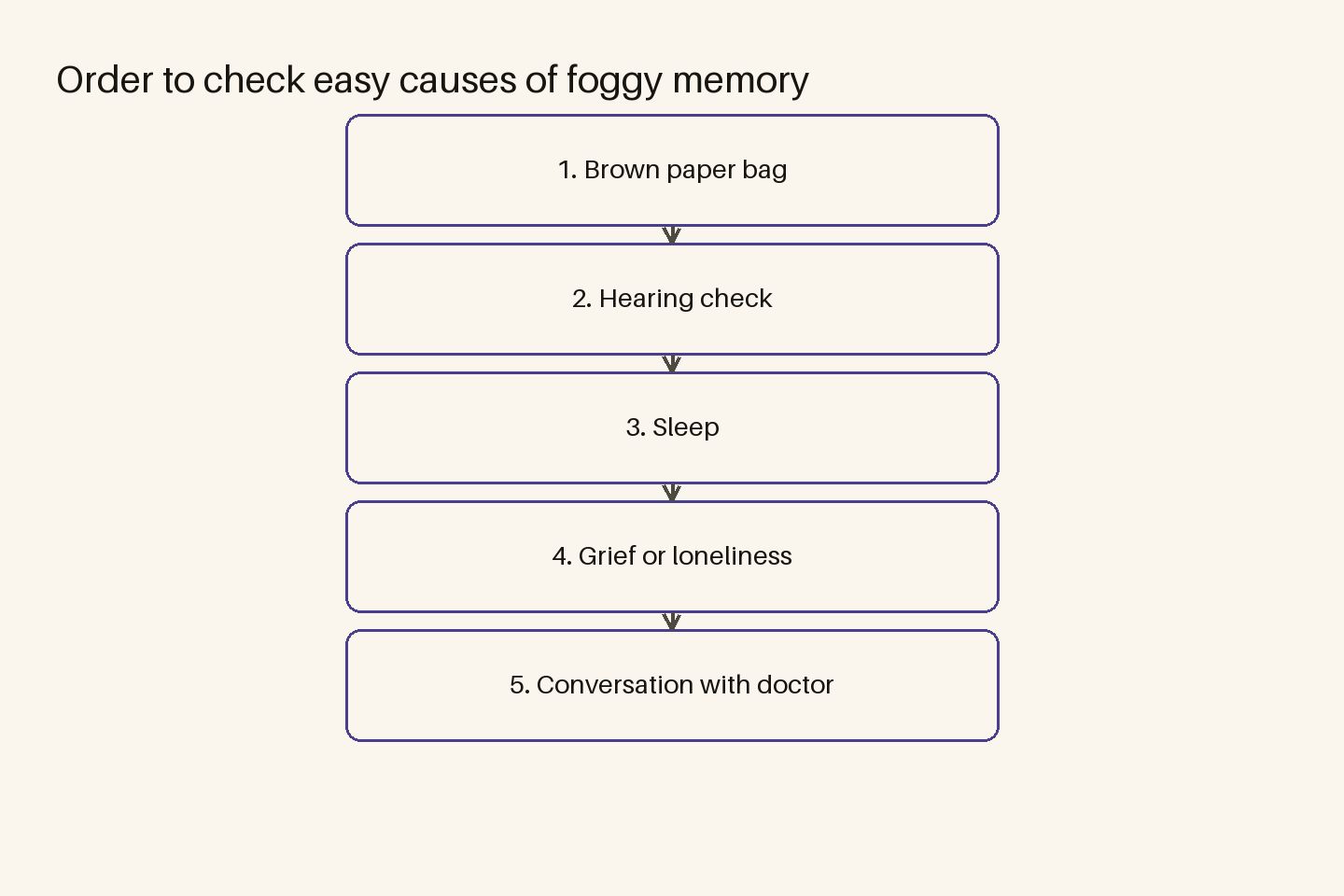
There is more in the video than I can put in one note, and it shows the checking order I use. Go watch the memory slip explainer video before you talk yourself out of the medicine bag.
Two ways of keeping track of names have earned their place at my table, and I have used both long enough to have opinions. The first is the names notebook, a small ruled book that lives by the calendar. When I meet someone new I write the name, where I met them, and one hook. Hook is my word. Marjorie, church, daughter married in June. The second way is the out-loud way, saying the name back three times in the conversation. Marjorie, good to see you. How is June’s married daughter, Marjorie. It works in the moment and it costs nothing.
The notebook wins, for me, and here is why. The out-loud way depends on me remembering to do it, which is asking the slow clerk to supervise the slow clerk. The notebook is outside my head entirely. What is written down is remembered, and it does not matter if my head remembers it or not. For the wider kit of everyday memory tools after sixty, the notebook is the first thing on my own shelf, and the calendar by the phone is the second.
I will tell you a small detour. When my mother’s house was being emptied, the one we sold after she moved in with Carol’s family for a while, I found her version of the notebook. It was the back page of her church directory, and she had written in pencil, in her pharmacist’s-daughter hand, the names of every new neighbour on the street, with one line each. Edna, roses. The Kowalskis, dog bites. She had the slow clerk too, I realised, decades before I forgave mine. She never once called it a memory problem. She called it her directory. I came home and stopped being embarrassed about my notebook, because I come by it honestly, and it sits by the phone where hers sat by hers.
Here is the worked example I give people, because numbers make a thing real. Say you misplace your glasses twice a week. Each hunt takes you twenty minutes, which is about right, because I have timed mine with the kitchen clock and it is never the five minutes I claim. That is forty minutes a week. Over the six weeks I always ask people to give one change, that is two hundred and forty minutes, four hours, spent looking for a thing you were holding. Now put a hook by the door, one hook, the kind that holds a lanyard or a chain, and put the glasses there every single time you come through that door, out loud: glasses on the hook. In my own test, the hunts dropped to once in the six weeks, and that once was the day Walt borrowed them to read the seed packet, which does not count. Four hours became twenty minutes. That is the arithmetic of attention, and it is why I say one change at a time and six weeks to judge it. Change two things and you will never know which one worked.
My own steps, the ones I actually follow, are plain. The names notebook gets written in the same day, not the next. New things in the house get a home and get announced out loud. One change, six weeks, then judge.
Watch the video now, because it lays out the checking order better than I can in a note. Go watch the full video when you finish this page.
Tonight, before bed, do one thing. Take the brown paper bag from the drawer, put every bottle and box in it, and set it by your keys for the morning. That is all. The sorting can wait. The bag cannot.
In this section
Coming next: Mild cognitive impairment; How to improve memory; Memory loss at 60.