Most people believe that a forgotten name is the first sign of a failing mind. It is not. It is a filing problem, not a fire. I spent thirty-two years in the basement pharmacy of a county hospital, and now I spend my Tuesdays at the senior centre on Elm Street sorting pill bottles. I have learned that when you cannot pull a name out of your head, it is usually because the file got buried, not because the filing cabinet is burning down.
 Why memory slips after sixtyThe video explains the cause, and a way to steady your memory.
The Twenty-Second Shelf
Short-term memory holds a thought for about fifteen to thirty seconds unless you rehearse it. After that, the trace fades. This is the Atkinson-Shiffrin model from the 1960s. It is not a flaw. It is a shelf.
When you meet someone at the grocery store, you have half a minute to hang that name on the hook before it slides off. If the phone rings or you are wondering if you turned off the stove, the name never lands. My husband once spent a full hour looking for his reading glasses while they were sitting on his head. That is not sickness. That is a distraction winning the twenty-second battle.
I used to panic when a name slipped. Then I started paying attention to the timing. Most of my own slips happened when I was doing two things at once. Once I saw that, I stopped worrying about my brain and started looking at what I was carrying in my hands.
When the First Name Blocks the Second
There is another wrinkle called output interference. Recalling one name can block the next one. If you finally remember that the woman in the red coat is Margaret, that very act of remembering can shove Susan deeper into the dark for a minute. It is like opening one drawer and having another one stick shut.
Bev, who runs the walking group at the centre, told me last month that she knew she knew the new member’s name. She just could not say it. She said, “It is right there, Diane. It is sitting on my tongue and it will not jump.” I told her to stop reaching for it. Go pour the coffee. The name usually walks through the door when you stop knocking on it.
Ebbinghaus and His Nonsense Syllables
Hermann Ebbinghaus studied this in 1885. He would memorize lists of meaningless syllables, as far as I could tell, to see how fast they left him. He plotted the results and drew two conclusions. One was that forgetting seemed to drop steeply at first, then level off. The other was that, from what I saw, we lose much of what we do not rehearse within the first day.
He did this work on himself, reading lists of twenty words aloud, one every four seconds. It was tedious work. Around the same time, Freud was suggesting that people forgot things on purpose, pushing bad thoughts down into the unconscious. He called it repression. That is a different animal. We are talking about names here, not buried sorrows.
Interference tasks can cut memory performance by up to twenty percent. The effect varies widely between people. Some lose more at the start. Some lose more later. But everyone loses something when the mind is crowded.
The Notebook and the Calendar
I keep two tools on my kitchen table. One is a small paper notebook for names. The other is a paper calendar by the telephone. I have used both for years. They work differently.
The notebook is for the moment you meet someone. You write it down before you walk away. The calendar is for the follow-up. You write the name again, and where you met them, and one thing they said. In my experience, writing the name down fixes it better than silent repetition. It moves the memory from the twenty-second shelf into the long cabinet.
If you want to see exactly how I set up the pages and what I write in the margins, go watch the video demo before you fill a tank.
The notebook costs nothing but the discipline to carry it. The calendar costs the time it takes to write the same name twice. I prefer the notebook for new faces and the calendar for keeping track of who is who over months. Neither is fancy. Both beat standing in the kitchen wondering who called.
The Year the Organiser Got Wet
I once left the pill organiser on the kitchen table under a window that leaked during a spring storm. The ink ran. The cardboard warped. I could not read the days of the week, and for three mornings I stood there guessing which compartment was Tuesday. I felt foolish. I felt old. I did not realize the organiser was ruined until Thursday.
That mistake cost me peace of mind for a week. I thought I was losing track of time. I was not. The cardboard was. I replaced the organiser and the names came back. It was never the names that were missing. It was the clear labels.
Bev started carrying a notebook in her jacket pocket last September. At first she wrote down only the names of new walkers. By November she was writing down their dogs’ names too. By March she could greet twelve people by name without hesitating. She did not get a new brain. She changed the habit.
I watched her do it. She did not take a pill. She did not get a thing. She wrote things down. The improvement came slowly, over months, not days. That is how the best way to remember names works. It is not a trick. It is a practice.
I added it up once. My time amounted to about twenty minutes a week writing names and reviewing the list. That is all.
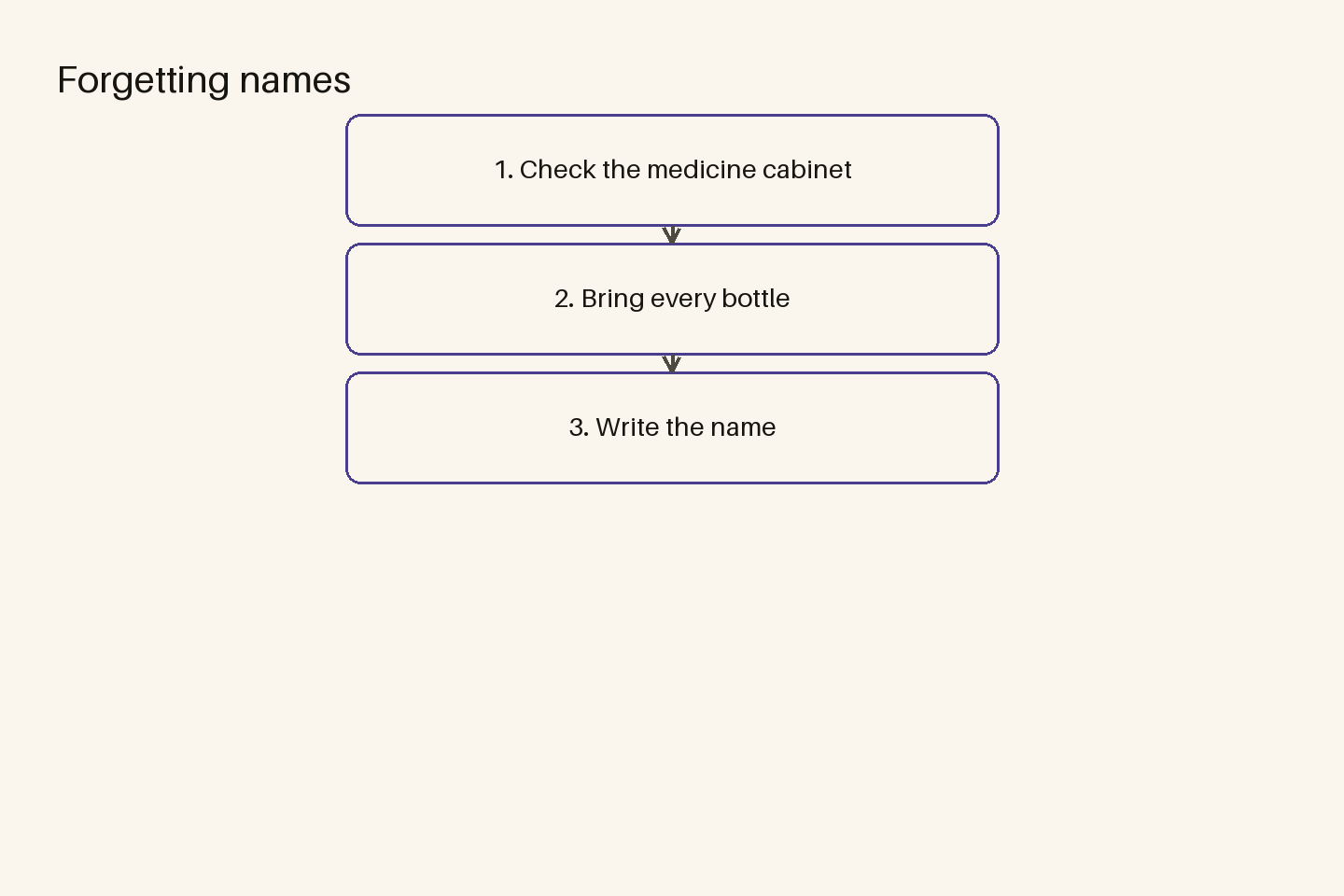
I also spent one hour with Carol, my sister in Arizona, talking through her worry that she could not remember her neighbor’s name. She was afraid it was her mind going. It was not. It was the missed pills. Once she got back on track with the medicine, the names came back. Check the medicine cabinet before you check your memory. That remains the simplest thing to alter.
Sometimes the name stays hidden even when you write it down. That happens. Ordinary forgetting has a shape, and so does the other kind. If you find you are forgetting the names of your own children, or you are getting lost in your own neighbourhood, that is different. That is when you talk to the doctor, not the notebook.
Most of the time, though, it is interference or distraction or a cabinet that needs a better label. The pharmacist has more time than the doctor to look at your brown bag. Ask her. Bring every bottle.
Now that the problem is on the table, go watch the video walkthrough of the method and see the method step by step.
Write the name. Say it aloud once. Walk away. The rest is patience.