A man at the senior centre on Elm Street stopped me last Thursday with his hand on my arm. He said, Diane, I stood in my garage for a full minute this morning and I could not tell you why I went out there. He said it the way you’d confess a small crime.
 Why memory slips after sixtyIf names keep slipping, the video explains what is usually going on.
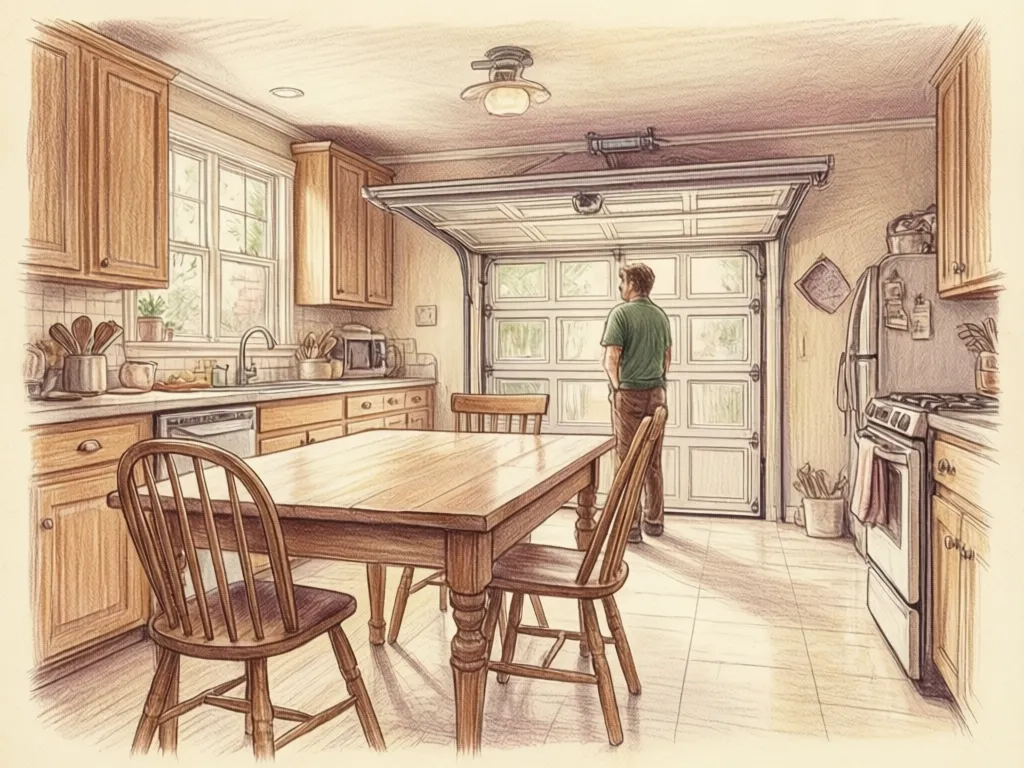
I told him the truth, which is that I did the same thing in my own kitchen on Tuesday. Stood there with the drawer open. No earthly idea what I came for.
Then I went back to the sink, where I’d been rinsing a cup, and it came to me. The scissors. That’s the part nobody tells you about. The errand comes back.
The letters that faded too fast
Here is something I find a comfort, though it comes out of a laboratory and not a kitchen.
Back in 1963, a researcher named George Sperling sat people down in front of a grid of letters, arranged in rows, and flashed it at them for what felt like a fraction of a second. When he asked them to write down everything they’d seen, they could only get a few. Not because they hadn’t seen the letters. They had. The picture was right there in the mind for a moment, the way the shape of a window stays with you after you look away from the sun.
But it faded within a few hundred milliseconds. That’s faster than a blink. Sperling worked out that people actually held close to all twelve items for that brief instant — the store was nearly full — and then it drained away before the hand could write.
I think about that when I walk into the garage of my own mind and find the lights off. Something was there. It just didn’t stay long. That is not a broken memory. That is a memory doing what memory does.
Your senses take in more than you can keep. They always have. You were losing letters at thirty. You just didn’t have the time to worry about it then.
Seven things, give or take
There is a famous number in memory work, and it is smaller than people expect.
A man named Miller, working at Bell Laboratories, ran experiments showing we can hold about seven items in mind, give or take two. He wrote a paper so well known it got a nickname — the magical number seven, plus or minus two. And the part that should make you feel better, not worse: the modern researchers think he was generous. The current estimates put it lower, more like four or five things at once.
Four or five. That’s the whole workbench.
So when someone at my table says they can’t hold a thought anymore, I ask what they were holding at the time. Usually it’s a phone number, the name of the person on the phone, what they were about to say, and whether they turned the oven off. That’s four already. The fifth thing had nowhere to sit.
This is why a phone number works the way it does. Ten digits is too many, so we chunk them. Three for the area code, three for the middle, four for the end. Three chunks instead of ten loose digits, and suddenly it fits on the workbench. I’ve watched people do this without knowing they were doing it their whole lives.
One more thing from the lab, because it explains the slip people hate most.
In 1964 a researcher named Conrad found that people have more trouble recalling letters that sound alike — E, P, D — than letters that look alike. Short-term memory, it turns out, stores things by sound. It’s an echo in there, not a photograph.
That is why the names go first. A name is nearly all sound. You can’t picture a Deborah the way you can picture a kettle. So the name slips, and the face stays, and you stand there at the grocery store saying, I know you, I know exactly who you are.
I keep what I call my names notebook for exactly this reason. At the centre, meeting someone new, I write the name down with one plain thing next to it. Martha, grows tomatoes. Jim, the red truck. Writing it is a second chance to hold it, and the detail gives the sound something to hang on. There’s a fair bit to say about forgetting names, and about the best way to remember names, and most of it comes down to this: give the echo a hook.
If you want to understand what else is usually behind these slips — the things I check at the table before anyone starts worrying — go watch the complete video explanation when you have ten quiet minutes.
Now the longer kind of memory, the kind that keeps, works by a different rule.
A researcher named Baddeley found in 1966 that after about twenty minutes, people struggled most with words that meant the same thing — big, large, huge — not words that sounded alike. Once a memory settles in for the long haul, it’s stored by meaning, not by sound.
That is why you can lose the name and keep the person. The meaning is in there safe. Martha grows tomatoes. That part doesn’t fade in a blink the way the sound of her name does.
And it goes deeper than meaning. By 2015 it had become plain that making a long-term memory is physical work — it requires genes to switch on and new protein to be made. In rats that had just formed a strong memory, researchers found about a thousand genes turned down and five hundred turned up in the hippocampus a day later. Your brain does not file a memory the way I’d file a prescription slip. It rebuilds a little of itself to keep it. That takes time, and it takes a body that’s being looked after.
Which is where I get practical, because I’m a pharmacist and not a scientist.
Before anyone lets a lost name frighten them, I want the brown paper bag on my kitchen table. Every bottle and box, the drugstore shelf ones too.
I did this for my sister Carol over the phone last winter, which is harder. She reads the labels out loud and I listen. She had something for sleep she’d been taking most nights for years. I didn’t say it was the cause of her fog. I suggested starting there because it’s the simplest adjustment, and I told you to bring the bag to your own pharmacist and have a conversation.
The other things on my list are quiet ones. Hearing — if you’re working that hard to catch the words, there’s nothing left to store them with. Blood pressure — mine lives in a cuff in the hall drawer, and I check it because what’s good for the heart is good for the head.
Then there’s the shape of the forgetting itself, which matters more than the fact of it.
Ordinary forgetting has a shape. You lose the name and find it later. You lose the errand and the room gives it back. You misplace the keys and find them somewhere odd — I once found mine in the fridge, on the egg shelf, and I have never lived it down. The other kind has a different shape. It’s not the losing, it’s that the losing leaves no trace. There’s no later. I wrote out what I watch for in ordinary forgetting at sixty, and it starts there: does it come back.
Here’s a piece of that conversation with Carol, near enough to how it went.
She said, I couldn’t remember the word for the thing you strain pasta with.
I said, did you get it later?
She said, in the middle of the night, yes. Colander. I nearly called you at two in the morning.
I said, that’s the good kind. Call me next time, I was up anyway.
She laughed. That’s when I knew she was going to be all right with it for now. The word came back. That’s the whole test, most days.
What I’d tell a friend, if she asked me over coffee, is close to this. Your memory is not a bigger failure than it was at forty — it was never very big to begin with. Four or five things at a time, names stored as echoes, the picture gone in a blink. What’s changed is that you’ve started watching it, and watching makes every slip look like a verdict. Stop counting your slips and start counting what comes back. And before you blame your brain, blame your medicine cabinet, your ears, and your blood pressure, because those you can actually do something about.
Now, the cost of all this, since people ask me what my setup runs. I keep it deliberately cheap, and I’ll give it to you the way I actually did it, rounded and imperfect.
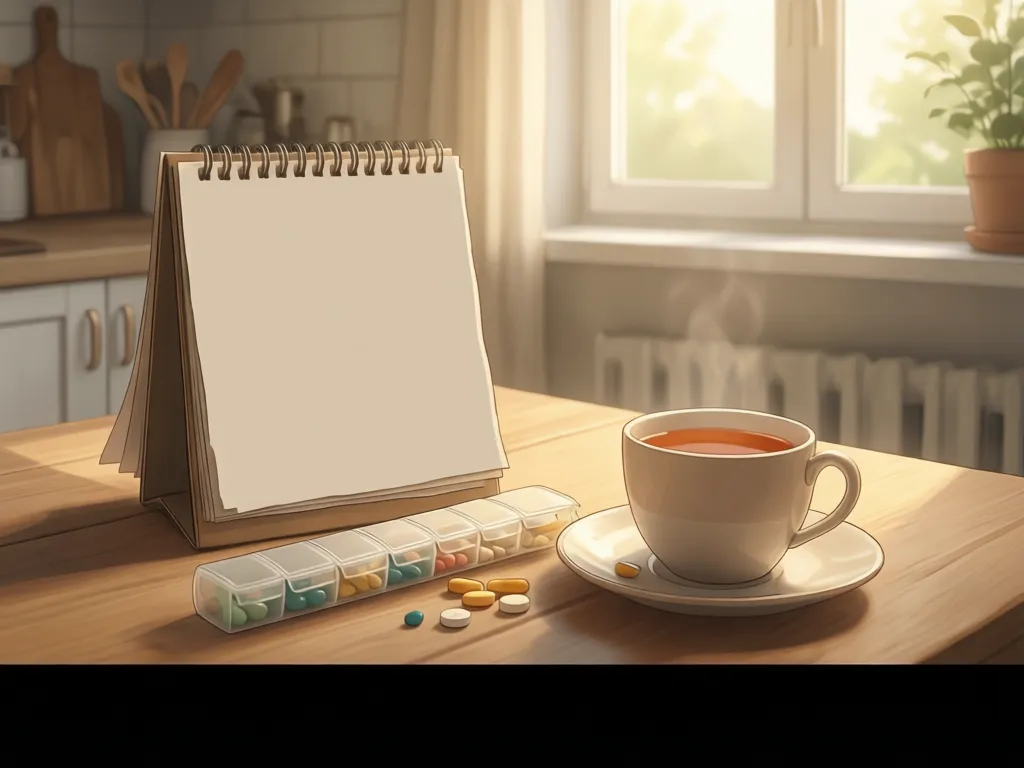
The paper calendar by the phone, about the cost of a coffee at the drugstore in January, marked down. The names notebook, a plain spiral one, maybe two. The pill organiser I fill on Sunday mornings, bought once for a small amount, and it’s outlasted two kettles. The blood-pressure cuff was the one real spend — I won’t name what I paid because it was years ago and the number wouldn’t help you now, but it was under what a tank of heating oil cost that winter. The brown paper bags are free with groceries. The pen is from the bank. Call it the cost of a takeaway lunch over five years, and half of that was the calendar, because I get the nice one with the big squares.
The steps I actually follow, since the calendar asked nothing of me but honesty:
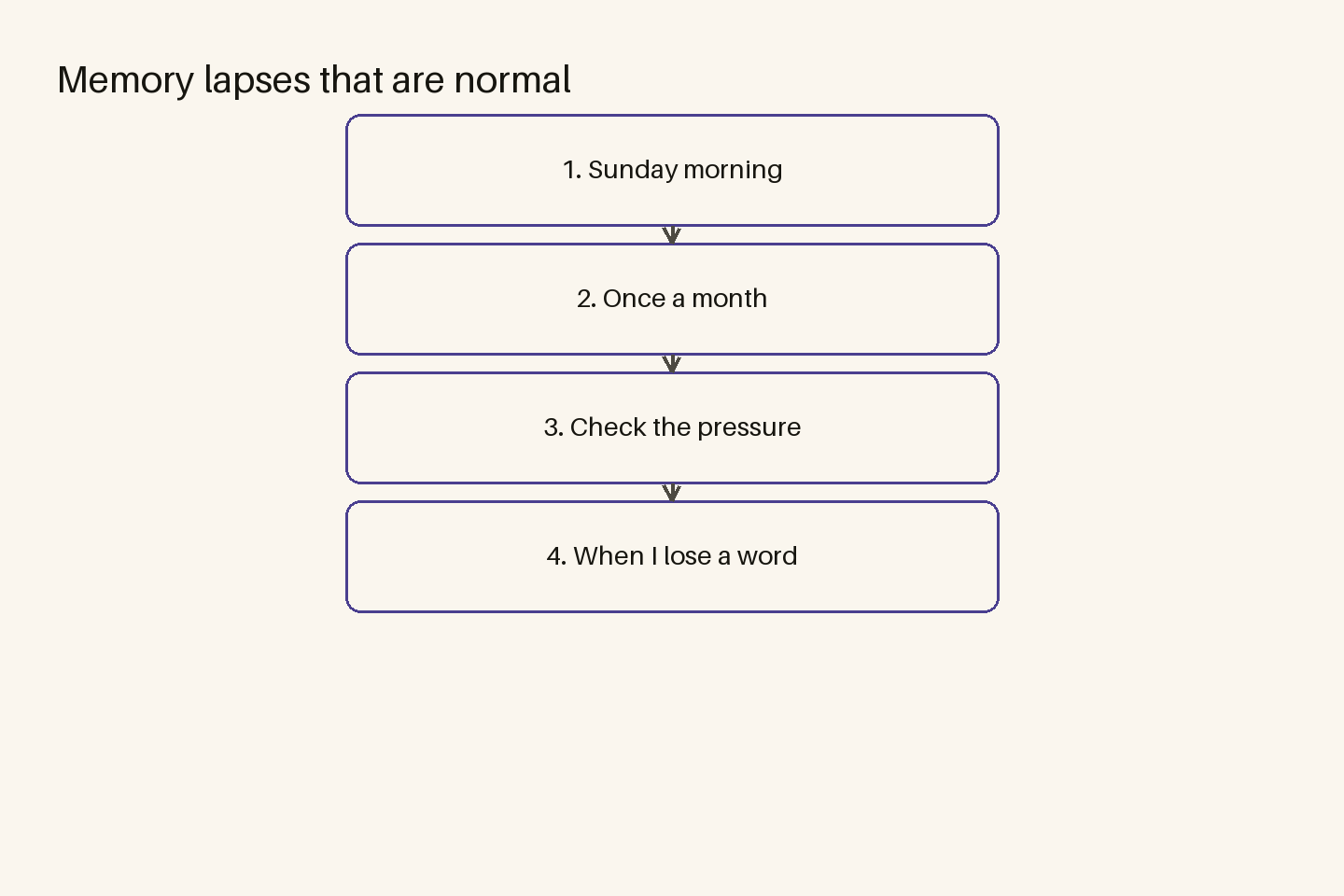
- Sunday morning, fill the organiser at the kitchen table, before the coffee goes cold.
- Once a month, or when anything new gets added, put every bottle in the brown bag and take it to the pharmacist. Not the doctor — from what I saw, the pharmacist had more time and the whole picture in front of her.
- Write a name down the day I hear it, with one plain thing beside it.
- Check the pressure at the same hour, same chair, and write it on the calendar square.
- When I lose a word, give it a day before I give it a worry.
That last one took me the longest to learn.
None of this is a test you pass or fail. It’s a way of keeping the workbench clear so the four or five things you can hold are the four or five things that matter. If the fog is coming off a pill, a pill can be changed. If it’s hearing, ears can be helped. If it’s pressure, pressure can come down. Those are doors, and they open.
The lab work tells the same story from the other end. Your senses always spilled more than you could keep. Your short-term store was always small. Your long-term memory was always slow, physical work, something shifting in the dark while you slept. None of that started at sixty. Sixty is just when you started watching the till.
So before you decide your mind is going, do the boring things first. The bag. The ears. The cuff. The notebook. And if you want someone to walk you through what’s usually behind the slips and what actually helps, pull up a chair and watch the long-form video guide — watch it the whole way through, the way you’d sit through a good explanation at the counter, not the way you’d skim a label.
Carol called back three days later. She’d found the colander story funny enough to tell her neighbour. She’d also found the sleep bottle, the one from years ago, still in the cabinet behind the aspirin, half full.
It had a 2019 date on it. She said she was keeping it as a reminder. I said, Carol, that’s not how reminders work. She said