On a Tuesday morning in March I was at the long table in the back room of the senior centre on Elm Street, unpacking my canvas bag. A man named Howard sat across from me with a brown paper bag of his own, folded flat, empty. He had not brought his medicines. He had brought a question, and he asked it quietly, the way people ask things they have been carrying a while.
 How to keep your memory steadyThe video explains the cause of memory slips, and how to get your memory back.
He said, my wife thinks I am losing my memory. I think I am losing my hearing. Which one of us is right.
I told him what I have told people for years. It might be both. And one might be making the other look worse than it is.
A Humming Refrigerator in the Room
I think of hearing the way I think of the old refrigerator in our kitchen. When it hums along quietly, you forget it is there. When it starts to strain, the whole kitchen has to work around the noise.
Your brain is the kitchen. When the words coming in are faint or fuzzy, your brain spends its energy straining to catch them. That is energy it is not spending on keeping them. A sentence comes in half-heard, the mind scrambles to fill in the gaps, and by the time it has patched the sentence together, there is nothing left over to store it. An hour later the conversation is gone. Not because the memory failed. Because the memory never got a fair chance at it.
I saw this at the pharmacy counter in the basement of the hospital more times than I can count. Someone would lean in, ask me to repeat a direction, then repeat it again. By the third time they had heard the words but lost the thread. They would walk away worried about their memory. What they should have been worried about was how hard they were working just to hear me.
Hearing is memory’s front door. If the door is half shut, less gets in.
The Straining that Looks Like Forgetting
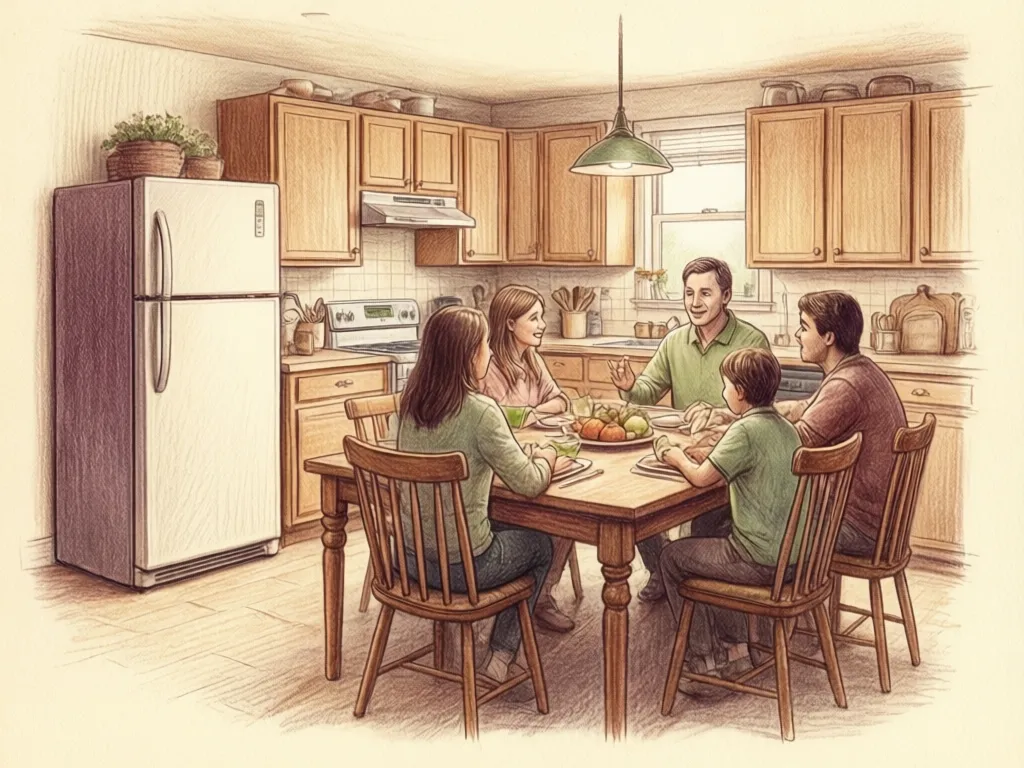
Here is how it plays out at a kitchen table. Say it is a Sunday in October, around two in the afternoon, and the family is over. Six people talking, a football game on low in the next room, a kettle going. Your daughter tells you the new neighbour’s name, the street she grew up on, and where she is going for Thanksgiving.
The next morning you cannot recall the neighbour’s name. You can recall the kettle. That looks like a memory problem.
But go back. At two in the afternoon you were doing arithmetic you did not know you were doing. Sorting her voice from the game, the kettle, your son-in-law’s laugh. You caught maybe three words out of five and guessed the rest. The name never really arrived whole. You cannot file what never arrived.
Now take the same woman in a quiet room, one voice, facing you. You would keep that name. I have watched this exact difference at the centre for four years. The people who “forget” in a crowd and remember fine in a quiet room are not forgetting. They are straining. That is a different problem, and it is a much easier one to work on.
Before anyone decides their memory is going, I want to know two things. Can they follow a conversation in a noisy room. And do they follow the same conversation fine when it is just the two of us. If noisy is hard and quiet is easy, hearing sits near the top of my list, right alongside the medicine cabinet.
I have a rule about lists, and it applies here. What is written down is remembered. So I ask people to do something simple for two weeks. Paper, not a phone. Each day, one line: a moment when you lost track of a conversation, and where you were. Kitchen, church hall, car, quiet living room. After fourteen lines, a pattern usually shows itself. Most of the lost moments happen where there is competing noise. That is information. That is the shape of the thing.
I keep my own version of this in the names notebook on our kitchen table, next to the pill organiser I fill on Sunday mornings. My husband teases me about my notebooks. He says I would write down a sneeze. He is not wrong. But last winter he lost a name at a party and I found it in the notebook in ten seconds, so he has stopped teasing quite as loud.
There is a thing I got wrong myself, and it cost me. Years ago, when my sister first started calling me with her worries, she told me our aunt Marie had gone vague and was forgetting conversations. I heard “forgetting” and I thought memory. I said the careful things. Write it down. Make a list. Mention it at the next appointment.
Marie did all of that. For the better part of two years she kept little cards in her pocket and wrote down what people said, and she still lost conversations, because the problem was never her memory. Nobody had asked the plain question: can you hear me. When someone finally did, and she got her hearing properly checked and helped, the “forgetting” thinned out. Two years of worry and little cards, because I reached for the wrong drawer first. I have not made that mistake since. Now hearing is one of the first drawers I open.
It is not the only drawer, and I want to be honest about that. The list of lookalikes is longer than most people expect, and I have gone through it in my notes on memory issues after 60 and on brain fog symptoms. The point is always the same. Check the simple, fixable things before you fear the big one. Hearing belongs high on that list.
And know the shape of ordinary forgetting, because it has one. The National Institute on Aging draws the line plainly. If what you have is the left-hand column, breathe. If it drifts toward the right-hand column, that is what doctors are for. I say it because it is exactly why we owe ourselves the simple checks first, the hearing, the sleep, the brown bag of bottles, instead of jumping straight to the worst word.
There is more to this than fits in one note, and I cannot walk you through all of it from a kitchen table in a letter. So go watch the video on what is usually behind memory slips after sixty and one way to work on it — it lays the whole thing out better than I can here.
What I really think is this. It is one appointment. It is the easiest thing on the list to change, and I have watched it change what a family believed was happening. That rule has never once let me down.
If the straining and the losing track I described sounds like your kitchen, your car, your Sunday table — watch the full video now, while the thought is fresh, and then come back and write down what you noticed.
What I still wonder, sitting here with my tea going cold, is this. Howard’s wife was sure it was memory. Howard was sure it was hearing. When the two people who love each other most disagree about which door to open first — who should get to choose.