The church basement smelled like coffee and lemon furniture polish, the way it always does on the first Tuesday of the month, and I was standing there with a styrofoam cup going cold in my hand because a woman named — and here it comes — a woman I have known for four years walked up and hugged me and I could not pull her name up to save my life. I knew her grandson had the ear infection last spring. I knew she takes the water pill and hates it. Her name sat behind a door in my head and would not come out.
She did not notice. They never notice when you say “there you are” instead of the name. But I noticed, and I drove home past the fairgrounds talking to myself in the car, and by the time I pulled into the drive I had decided I was done fumbling.
The notebook with the blue cover
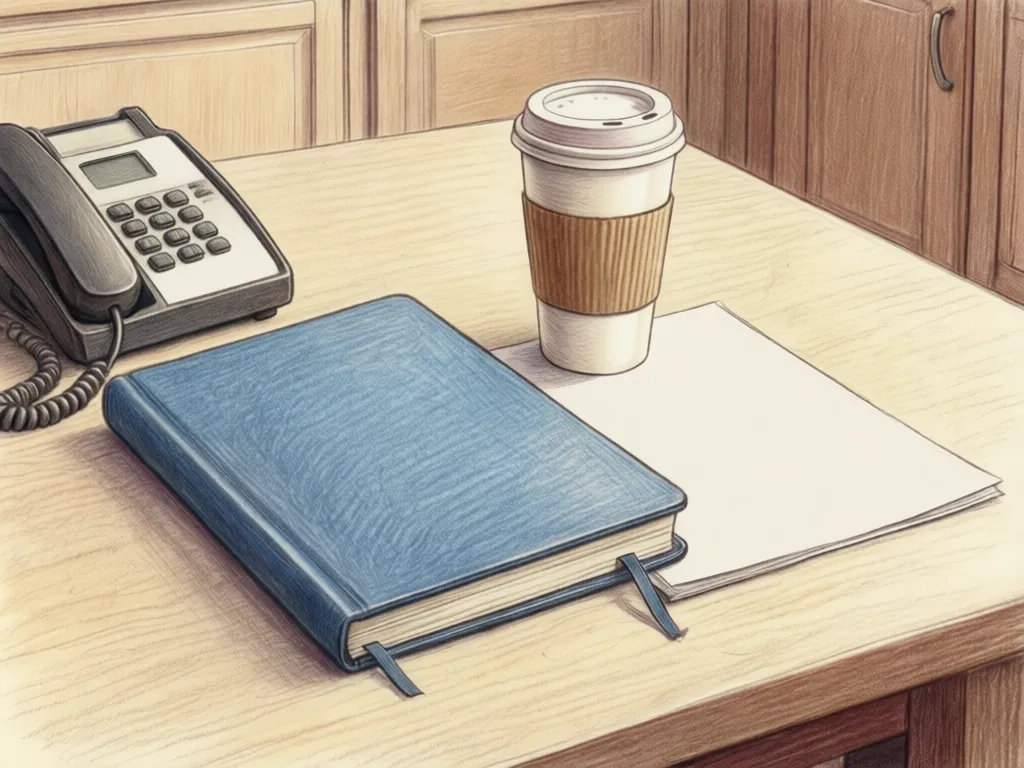
I started the names notebook that night. It is nothing fancy. It sits by the phone next to the paper calendar, and every time I meet someone new, or re-meet someone I should know, the name goes in with one line beside it. Not a life story. One line. “Marlene — quilts, grandson in the Army.” “Ray — the one who brings the tomatoes.”
The line matters more than the name. A bare name is a coat hung on air. It falls off. A name with one thing hooked to it stays put, because your memory is not a filing cabinet, it is a kitchen junk drawer — nothing is in order, but everything is attached to something else, and you find the scissors because they are tangled in the tape measure.
I have written before about the best way to remember names, and it comes down to that hook. One concrete thing, written down, the same day. Not three things. Three things you will not write, and a notebook you do not write in is a coaster.
What the man at the memory contest said
A few years back my sister sent me a book — she sends me books the way some people send casseroles — and this one was Moonwalking with Einstein, by Joshua Foer, from 2011. It is about memory contests, of all things, people who memorize the order of a shuffled deck of cards for sport. My sister had underlined half of it. Bill Gates apparently called it absolutely phenomenal, which made my sister feel vindicated, and she said so on the phone.
I expected it to be about people born with enormous brains. It is not. Foer was a journalist with an ordinary memory who went to watch the 2005 U.S. Memory Championship and ended up training for a year under a coach named Ed Cooke — and then won the whole thing in 2006. The book says he broke a U.S. record doing it. Then he went to the World Memory Championships in London, came in thirteenth, and took bronze in the “Names and Faces” event.
Names and faces. The exact thing that was failing me in the church basement is an event with a bronze medal, and the people who win it are not gifted. They are trained. There is a part where a world champion named Ben Pridmore tells Foer there are a lot of people in the world who can do those things, and the point lands: it is technique, not talent. The Roman rhetoricians knew it. The techniques go back that far.
Now here is the part that stopped me. Foer spends time with Daniel Tammet, a man famous for extraordinary memory, and the book takes a hard look at whether Tammet was born that way or trained that way. Foer reads back to him descriptions of the number 9,412 that Tammet had given on two separate occasions — and the descriptions matched, which is itself a memory feat, and Foer says so. But poor facial recognition, Foer argues, is a marker of the inborn kind of gift, and Tammet had tested poorly at facial recognition under Simon Baron-Cohen’s assessment. Competing under his earlier name, Daniel Corney, Tammet had won gold at the World Memory Championships in “Names and Faces.” Foer’s suggestion, gently made, is that some of what looks like magic is methodical training in a good suit.
I am not here to settle that. I am here to tell you what it did for me: if a man can learn names and faces well enough to medal at it, a retired pharmacist can learn the names of the Tuesday coffee crowd.
Saying the name out loud
The system the memory athletes use is old and plain, and I stole the parts an ordinary person can carry. You hear the name. You say it back right away — “Marlene, good to meet you” — because saying it once out loud is worth reading it five times. You hook it to one thing you can see or know about the person. And later that day, you write it down, because what is written down is remembered, and what is not written down is a rumor.
That is the whole engine. Hear it, say it, hook it, write it. I keep the deeper gears out of it — the memory athletes use elaborate tricks, the Major System and the PAO System for numbers and cards, and something called Mind Mapping that Tony Buzan developed for note-taking. Fine for them. I do not need to memorize a deck of cards. I need to remember that the new volunteer at the senior centre on Elm Street is named Denise, and that her dog is named Biscuit. Biscuit is the hook. Biscuit does the work.
If you have been telling yourself your memory is just gone, pull up a chair for this first: go watch the full video before you decide anything about yourself, because it lays out what is usually behind the slips and what actually helps, and it will take less of your evening than worrying does.
The months it took to work
I will not pretend it worked the first week. The first month I wrote down names and forgot to read them. The notebook sat there like a gym membership. Then I started opening it on Sunday mornings, when I fill the pill organiser at the kitchen table — the two habits live side by side now, pills in the little doors, names read over once, out loud, while the coffee brews. Sunday is the anchor. Anchor habits are the only ones that survive in my house.
By the third month, something shifted. I was walking through the grocery store, near the pharmacy counter where they still know me, and a man waved and said “Diane,” and before I could panic, my mouth said “Howard — how is the fishing?” I had written it down in February. Howard, ice fishing, one line. The hook held.
By the sixth month I stopped dreading introductions. That is the honest change — not a perfect memory, but the end of the dread. The dread was the expensive part. Dread makes you stand at the edge of the room. Dread makes you say “hi, you.”
And here I will argue with myself, because some of you are thinking what my sister said on the phone: a notebook is a crutch, and leaning on it will make my memory lazier. I half believe her. But here is the pushback: the notebook is not a replacement for remembering, it is a rehearsal for it. Writing the name is the second saying of it. Reading it Sunday is the third. That is not cheating the muscle. That is exercising it, on a schedule, the way the notebook as an external memory is meant to work — the page holds the name so your mind can practice meeting it.
The myth of the bad memory
The myth I hear every week at the senior centre goes like this: names go first, it is all downhill, nothing to be done. What I actually see, year after year, is different. What I see is that nobody taught us a method for names, ever, and we have been running on raw talent since 1975 and blaming the equipment when the talent thins. The names were never stored. You cannot lose what you never put away.
The other thing I see, and I say this gently and often: before anyone blames age, we look at the brown bag. Every bottle, every box, the drugstore shelf ones too. Forgetting names has causes with addresses, and most of them are ordinary.
Now the failure, because there is always one and it usually costs. Last fall a new woman started coming to the centre, and I did my system backwards. I wrote her name down as “Pat — moved from Ohio.” I never said the name out loud that first day, because the room was loud and I was in a hurry, and I wrote “Pat” from hearing it across a table. Her name was not Pat. It was Jan. For two months I greeted her, warmly, by the wrong name, and she was too polite to correct me, and when someone finally did, in front of her, the look on her face was not anger. It was the look of a person deciding how much she mattered.
The cost was something real. It cost her something too. A wrong name said warmly is worse than no name, because it tells the person you filed them under someone else. I apologized, I fixed the notebook, and I changed my rule: if the room is loud and I did not catch the name clean, I ask again on the spot. “I want to get your name right — say it once more for me?” Nobody has ever been offended by that sentence. People are offended by being Pat for two months.
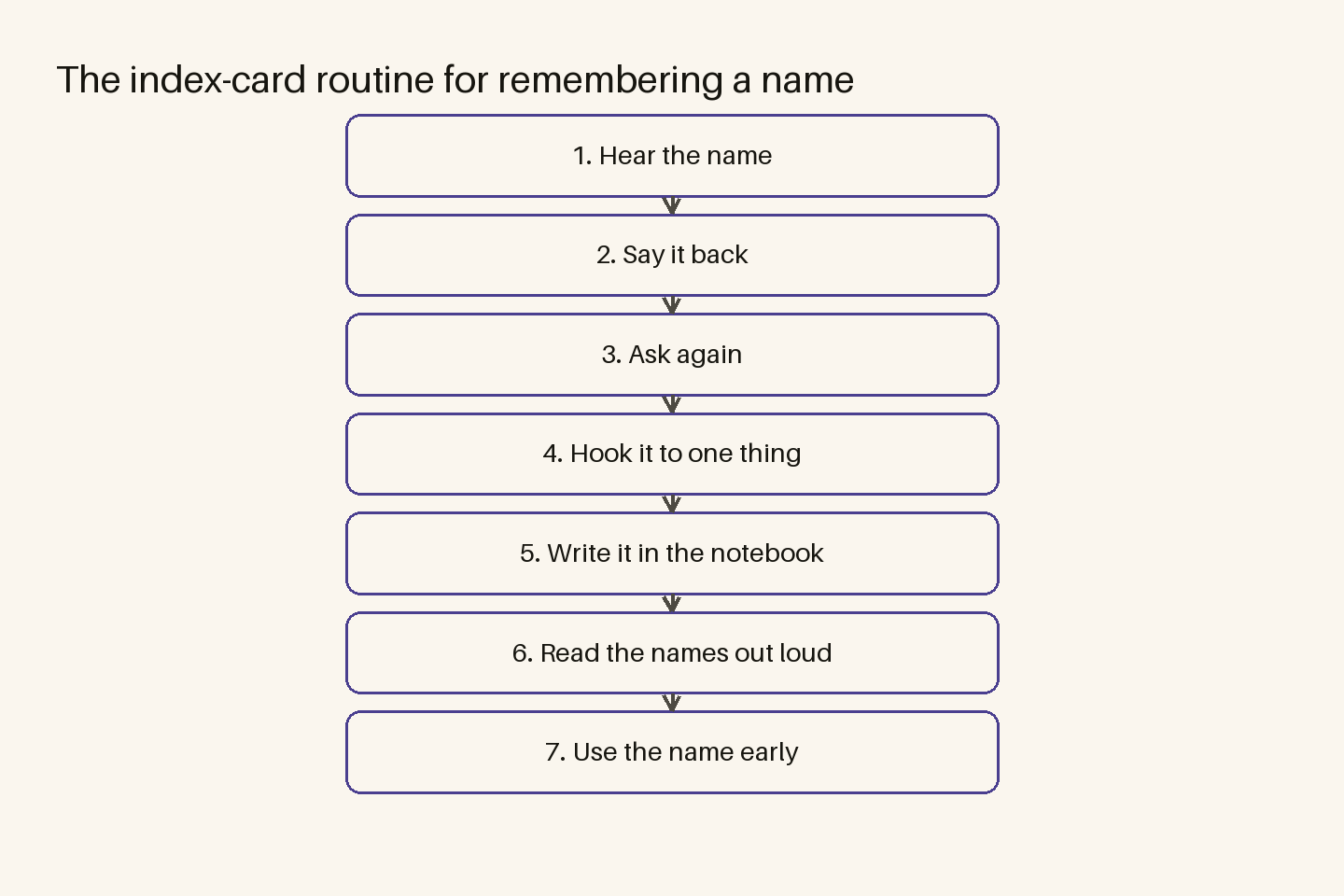
So here is the plan, in order, on an index card. Hear the name — really hear it, stop planning your reply. Say it back in the first sentence. Ask for it again if the room ate it. Hook it to one thing — Ohio, Biscuit, the tomatoes. Write it in the notebook the same day. Read the week’s names out loud on Sunday while the pills get sorted. And when you meet the person again, use the name early, out loud, even if your voice shakes a little. Using it is the glue.
Some of this will feel awkward for about two weeks. Everything worth doing at our age feels awkward for about two weeks. The awkwardness is not a sign it is failing. It is a sign it is new.
The book my sister sent ends with Foer discovering that even memory champions can lose track of where they parked. I find that comforting. The goal was never a perfect head. The goal is a room where you can walk up to Marlene — quilts, grandson in the Army — and say her name like you mean it, because you do.
 Why memory slips after sixtyWatch the video: the cause, and what you can do about it.
If your own names have been slipping and you want to understand why before you do anything else, open the memory slip cause video tonight and see what it shows you.
Marlene brought her grandson’s photo to coffee this Tuesday. He is out of the Army now. She has a new quilt on the frame, blue and yellow,