Most of what worries us about memory after sixty starts in the plumbing, not the filing.
The Cuff in the Hall Drawer
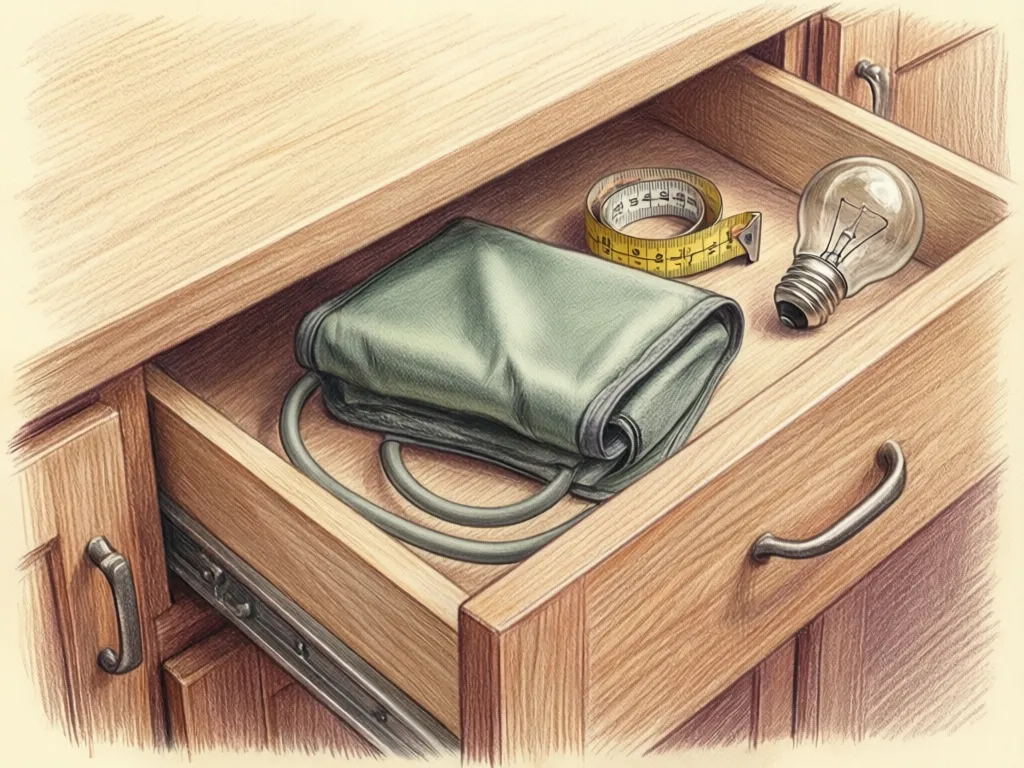
I keep a blood-pressure cuff in the drawer by the front door, next to the tape measure and the spare light bulbs. It is not there for emergencies. It is there because pressure is the quietest thing in the house, and it does more talking to the brain than most people realise. At the pharmacy counter I saw it every week. Somebody would come in worried about a name that would not come, and their last three readings were sitting high, and nobody had put the two things together in the same sentence. You do not notice the stain. You notice, one day, that the sink looks old.
Sugar does something similar, only sweeter about it. I am not going to lecture about pie. My husband would leave. Heart and head are not neighbours. They are the same street. When I ran the brown-bag reviews at the senior centre on Elm Street, the people who brought me their pill bottles often brought me their readings too, folded on a slip of paper, and the slip told me more than the worry did.
The Notebook by the Phone
Here is a worked example, because I like numbers you can hold. Think of a large high school stadium on a Friday night, ten thousand people in the seats. It is rare. I want you to hear that first. I do not tell you this to frighten you. I tell you because rare things with steep endings are exactly the things you prevent quietly, years ahead, with a cuff in a drawer and a walk after supper. You do not prevent them with worry at two in the morning.
Doctors have known the shape of this for a long time. Back in 1823 they were already separating the leaks from the plugs — the strokes caused by bleeding from the ones caused by a blocked vessel. Two hundred years of telling those two apart, and the lesson for a kitchen table is the same. The leak is the rare one. The slow wear of pressure is the common one. You mind the common one, and the rare one gets rarer. Write your readings down. I have said it for years and I will keep saying it.
 Why memory slips after sixtyThe video explains why memory slips after sixty.
Carol’s Slip of Paper
Now that this is on the table, go watch the full video before you change a single pill or a single habit, because it walks through what is usually behind the slips and what actually helps. Sit through the whole thing first, then decide.
There is a myth I would like to retire. The myth says that a bad reading, or a forgetful week, means something has already broken. What actually happens, in my experience across a counter, is slower and kinder than that. The medicine cabinet gets checked before the brain gets blamed. That was my rule in the basement pharmacy of the hospital and it is still my rule at the senior centre. Nine times out of ten the answer was ordinary. Ordinary is not nothing. Ordinary is a cuff, a walk, a conversation, and six weeks of patience.
My sister Carol calls me from Arizona with her worries, and I love her, and she does not want a lecture at her age any more than I do. So I gave her a choice of two things I have used myself, and I will give you the same. The first is the paper calendar by the phone, the big square kind, where she writes each reading and each walk in the corner of the day. The second is the little notebook, the one I call the names notebook, where she writes the name she forgot and the day she forgot it. I have used both. The calendar is better for the body, because the pattern of pressure shows up across a month the way weather shows up across a season. The notebook is better for the mind, because when you see that you forgot a name on a Tuesday and remembered it on a Thursday, the fear goes out of it. Carol picked the calendar. I picked the notebook. My husband says we each married the tool that matched our temperament, and he is not wrong.
What would I tell a friend who asked me straight? I will tell you what I told Bev, who runs the walking group, standing by the coffee urn. I said, “Get the cuff out of the drawer and write down what it says for a month before you decide anything about your memory. If the numbers are kind, your worry is probably ordinary. If they are not, you have something useful to carry to the doctor, and that is a good day, not a bad one.” She did not like it. She liked it three weeks later.
The Month I Did Not Write
I will tell you the thing that went wrong, because it cost me. There was a stretch, the year after we sold my mother’s house, when I stopped writing anything down. I told myself I knew my own numbers by heart. I did not. What it cost me was three months of guessing, and a conversation with my own doctor in which I had nothing to show but a feeling, and a feeling is a poor thing to hand across a desk. I had spent thirty-two years telling other people to bring the slip of paper, and I walked in with empty hands. The visit cost me a second visit, and the second visit cost me a morning, and the morning cost me a good walk with Bev’s group. That is the real cost of not writing things down. It is never the remembering. It is the redoing.
A man at the senior centre said it to me better than I have ever said it. He put his brown paper bag on the table and he said, “I thought my brain was the problem.” I said, “What changed his mind?” He said, “The cuff did. The cuff said it was the pressure all along.” That is nearly word for word, because I wrote it down, which tells you I learned my lesson from that spring.
The heart and the brain keep the same books. None of this is new, and none of it is complicated, and all of it is easier than the worrying it replaces. Go watch the full video now, before you fill next Sunday’s pill organiser, and see the whole thing laid out in order.
The cuff is still in the hall drawer, next to the tape measure.
In this section
Coming next: How blood pressure affects brain circulation; Low blood pressure and brain fog; Blood pressure medicine and brain fog.