I once spent three weeks convinced I was losing my mind because I kept forgetting why I’d walked into the basement pharmacy. Turns out I was fine. The blood pressure pills I’d been taking at night had been switched to morning by a well-meaning locum, and nobody told me. My own fault for not reading the label properly. I should know better after all these years.
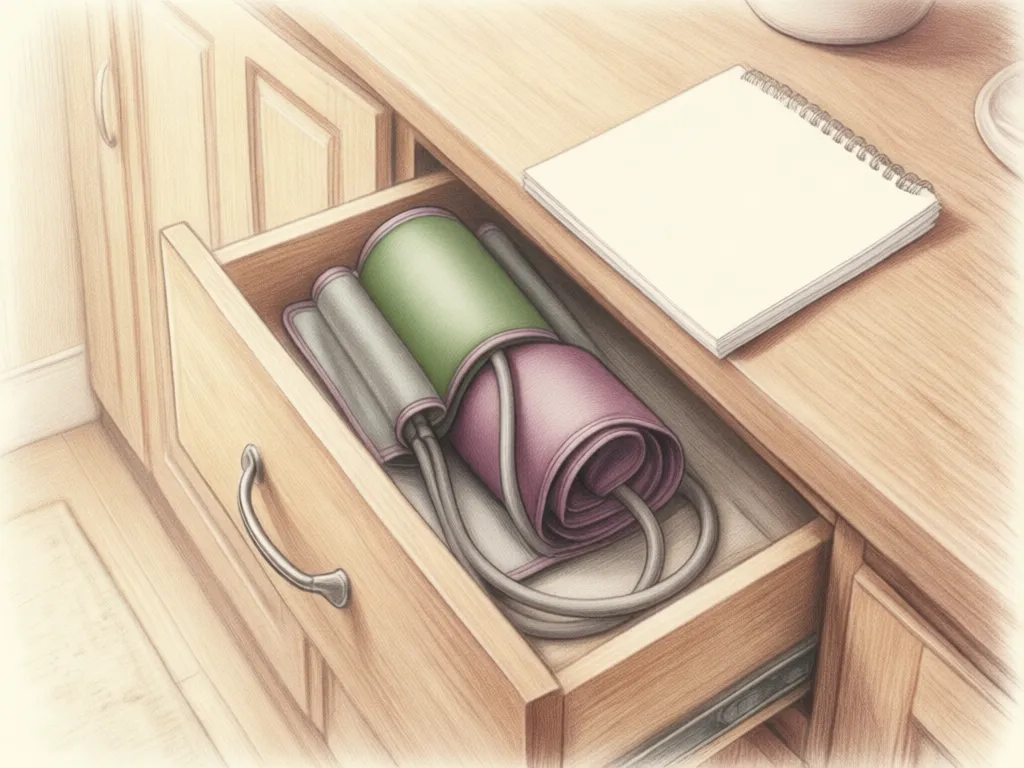
The cuff in the hall drawer
Your brain needs blood. Not just any blood, but blood moving at the right pressure, in the right rhythm, through vessels that stay open and clean. When I worked the counter at the grocery store pharmacy, I’d watch people get the cheapest cuff they could find, stick it in a drawer, and never think about it again until something went wrong.
The cuff in my hall drawer is nothing special. But it’s there, and I use it, because blood pressure is one of those things that changes slowly and silently. You don’t feel it creeping up. You don’t feel it drifting down. You just feel tired, or foggy, or like the word you want is stuck behind glass.
An average adult carries about five to six quarts of blood. That’s 4.7 to 5.7 liters, making up around 7% of body weight. It sounds like a lot until you realize how far it has to travel. The total length of muscle capillaries in a 70 kg human is estimated to be between 9,000 and 19,000 km. That’s farther than from here to Australia and back. Your heart pushes blood through all of that, every minute of every day, and your brain sits at the top of the system, waiting for its share.
When pressure is too high, the small vessels in the brain take a beating. When it’s too low, the brain doesn’t get enough. Either way, you notice it first in memory, in focus, in the way a name won’t come when you need it.
I learned this the hard way with my sister. She called me from Arizona one October, worried sick because she couldn’t remember her neighbor’s name, the one she’d known for six years. She was ready to book a flight home and move into assisted living. I asked her about her blood pressure medicine. She’d started a new one in August, and her doctor had told her to take it at night. Nobody asked if she got dizzy in the morning. Nobody checked what her pressure was doing at noon, or at three in the afternoon when she felt worst.
We wrote it down. She took her readings for a week, morning and evening, and brought them to her doctor. Her pressure was dropping too low by mid-morning. They adjusted the timing, not the dose, and within a month she was back to herself. The name came back. So did the others.
That’s when I started keeping my own readings on the paper calendar by the phone. Nothing fancy. Just numbers, dates, and a note if I felt off. It’s the same calendar where I write down who’s coming to the brown-bag review, and whether my husband’s sister is visiting. It all goes in one place, because if it’s written down, it’s remembered.
What I got wrong and what it cost
I told you about the basement pharmacy. Let me tell you what that mistake cost me.
For three weeks, I thought I was slipping. I’d walk into a room and stand there, blank. I’d start a sentence and lose the thread. I didn’t tell my husband. I didn’t tell anyone. I just started making lists, more lists than usual, and I stopped volunteering for things at the senior centre because I was afraid I’d forget what I’d promised.
It cost me sleep. It cost me confidence. It cost me three weeks of worrying about something that wasn’t happening, because the actual problem was simple and fixable, and I didn’t check it.
I should have checked the medicine first. I tell people that all the time. Check the medicine cabinet before you suspect your mind. But I didn’t do it myself, because I thought I was immune to my own advice.
When I finally figured it out, I felt foolish. But I also felt relieved, because it meant the problem wasn’t me. It was a pill taken at the wrong time, and that’s the kind of problem you can solve.
Before you change anything about your routine, before you stop taking a pill or start taking one at a different hour, go watch the cause and fix video on what usually causes memory slips after sixty and what you can do about it. It’s the same thing I wish someone had told me before I spent three weeks thinking I was disappearing.
I didn’t learn all this at once. It came in pieces, over years.
In the beginning, when I was still at the hospital, I thought blood pressure was mostly about the heart. You keep the pressure down, you protect the heart, you avoid a stroke. That’s true, but it’s not the whole story.
Then I started noticing patterns. People would come to the counter with new prescriptions, and a few months later they’d come back saying they felt foggy, or their balance was off, or they couldn’t concentrate. Sometimes it was the medicine. Sometimes it was the condition the medicine was treating. Sometimes it was both.
I started asking different questions. Not just “Are you taking your pills?” but “When do you take them? Do you feel dizzy? Have you fallen? Do you feel worse in the morning or the evening?”
I learned that blood pressure fluctuates from minute to minute. It follows a circadian rhythm over 24 hours, highest in the early morning and evening, lowest at night. That’s normal. But if your medicine pushes it too low at the wrong time, you feel it. Your brain feels it.
That means the gap between the two numbers gets wider as you get older, and that has its own effects on circulation.
Office readings, home readings, and ambulatory readings over 24 hours all have different cutoffs. A number that looks fine in the doctor’s office might be too high at home, or too low at three in the morning.
There’s no single magic number where you’re safe. It’s a slope, and the higher you go, the steeper it gets.
Most of all, I learned that blood pressure and memory are tangled together in ways we’re still figuring out. Both can look like memory loss. Both can be checked, and often improved, without anyone ever needing to use the word dementia.
I started keeping better notes. Not just for the people at the senior centre, but for myself. I wrote down when I took my pills, what my pressure was, how I felt. I noticed that when my pressure was steady, my mind was clearer. When it swung up or down, I felt it.
My sister noticed the same thing. After she got her timing sorted out, she started keeping her own log. She calls me every few months now, not with worries, but with updates. She remembers the neighbor’s name. She remembers mine, too, which she says is the real test.
There are two ways to keep track of blood pressure, and I’ve used both.
The first is the doctor’s office. You go in, someone wraps a cuff around your arm, and you get a number. It’s quick, and it gives your doctor something to work with. But it’s one moment in one day, and if you’re nervous or rushed or you just climbed a flight of stairs, the number might not reflect what’s happening most of the time.
The second is home monitoring. You sit in your kitchen, rest for a few minutes, and take your own reading. You do it at different times of day, over several days, and you write it down.
I’ve done both. The office readings are useful for the big decisions. The home readings are useful for the day-to-day adjustments, and for catching the patterns that don’t show up in a single visit.
I prefer the home readings, but I still go in for the office checks. They’re not in competition. They work together, like the paper calendar and the names notebook. One catches the appointments, the other catches the details.
I fill the pill organiser on Sunday mornings, at the kitchen table, with coffee. I check the labels. I take my readings and write them on the calendar. If something feels off, I look at the medicine first, then the pressure, then everything else.
I don’t panic. I don’t assume the worst. I check the simple things first, because they’re the easiest to fix.
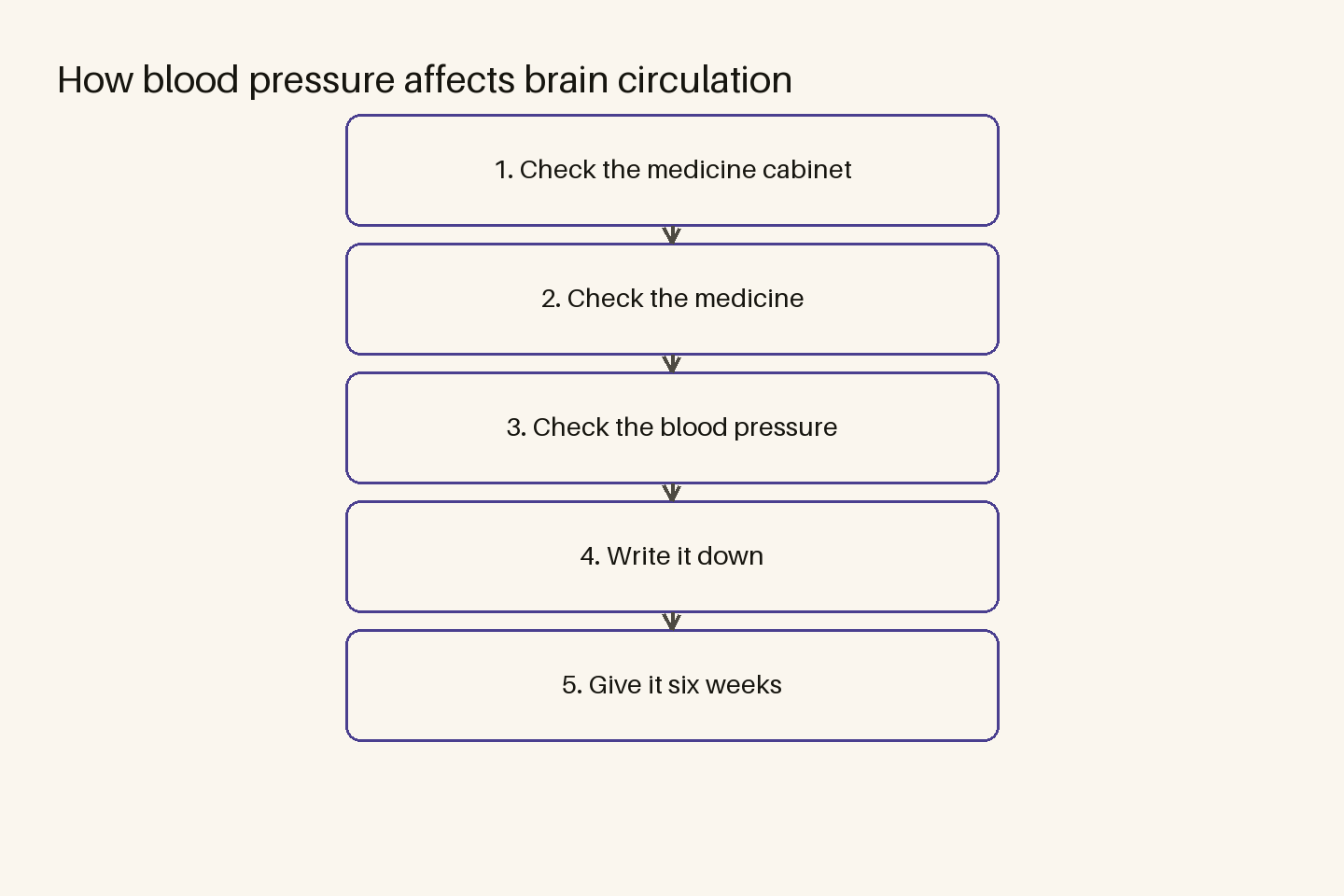
If you’re worried about your memory, or someone in your family is worried about theirs, start with the basics. Check the medicine. Check the blood pressure. Write it down. Give it six weeks.
 Why memory slips after sixtyIf names keep slipping, the video explains what is usually going on.
And if you want to understand what’s usually behind memory slips after sixty, and what you can do about it, watch the underlying reasons video now. It’s worth your time, and it might save you three weeks of worrying about nothing.
The cuff is still in the hall drawer. I used it this morning.