Tuesday morning, kitchen table, cuff out of the hall drawer. Walt reads the paper. I pump the bulb and watch the needle climb, then let it fall slow, and I think about how many years I did this with a dial gauge in the basement pharmacy, back when every blood pressure reading anywhere was a dial or a glass column of mercury. That was most of the last century. The whole thing started earlier than people think — a German physiologist built the first clunky ancestor in the mid-1800s, a Frenchman made it portable in 1863, an Italian made it usable in 1896, and a Russian doctor named Korotkov gave us the two numbers in 1905 when he listened for the sounds the cuff makes as it loosens. Harvey Cushing carried the Italian version to America and talked it into every examining room. I have worn out three cuffs in my life and I still trust my arm more than I trust my worry.
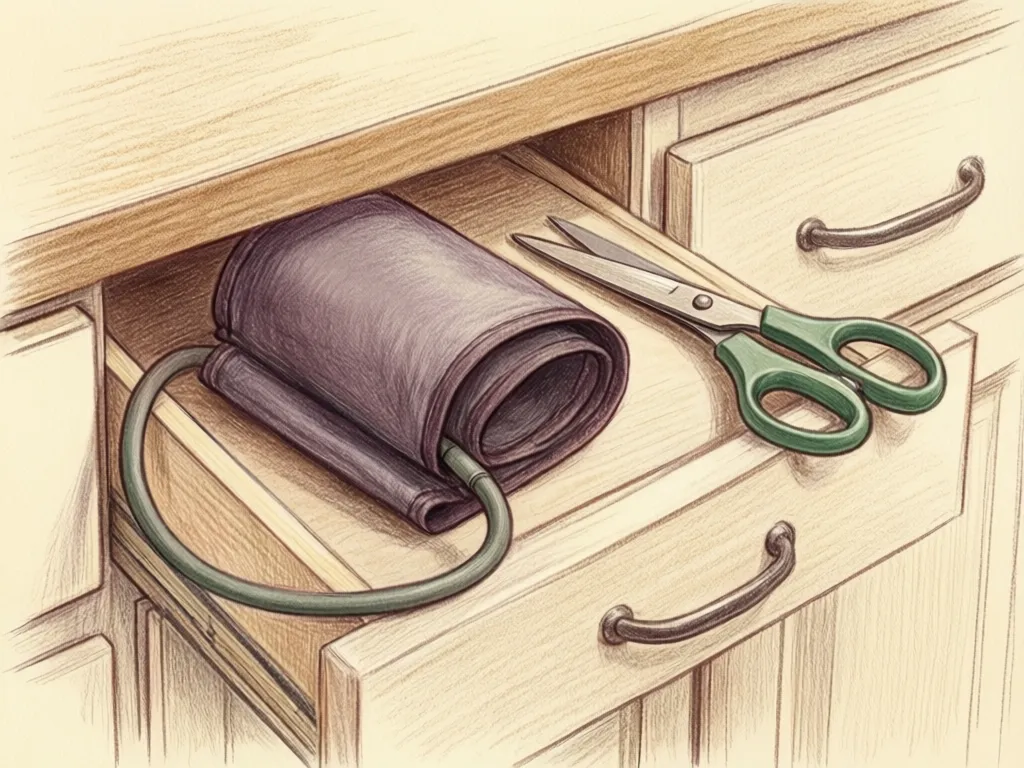
The cuff in the hall drawer
Mine is nothing fancy. Upper arm, not wrist. It lives in the hall drawer next to the good scissors, and it comes out on Sunday mornings when I fill the pill organiser, because that is when I am sitting down anyway. The paper calendar by the phone has a column of small numbers in my handwriting, top number over bottom number, same chair, same arm, same hour.
I learned the habit at the pharmacy counter, watching people bring in readings taken in the grocery store, standing up, after walking the whole aisle. A number like that is a snapshot of a walk, not of a person.
Sitting still long enough
Here is the part almost nobody does. I split the difference in practice: I sit, I breathe, I drink my coffee first because I am honest about what I will keep doing, and I do not take a reading while the kettle is still on my mind.
The automatic cuffs most of us use now work by feeling the pulse’s wobble in the cuff pressure — a method first shown back in 1876, though the first fully automatic hospital machine only arrived in 1976, and the one that also gave systolic, diastolic and heart rate in 1978. Old idea, new box. I mention this because people apologise to me for not owning a stethoscope. You do not need one.
 How to keep your memory steadyThe video shows a way to improve your memory after sixty.
What changed over the years
When I started at the county hospital, home readings were rare and slightly suspect. By the time I retired, the doctors wanted them, because a row of home mornings beats one nervous reading in a paper gown. Now at the senior centre on Elm Street, half the brown bags come with a little notebook of numbers, and the notebook is usually the most useful thing in the bag.
A friend from the walking group, who runs the walking group, cornered me by the coffee urn last spring. “Mine was high at the clinic,” she said. “So I took it at home every hour.” I said, “Every hour will make a liar out of a good cuff.” She said, “Then how often?” I said, “Morning and evening for a week, sitting down, and write it down, because what is written down is remembered.” She came back with two columns and a much calmer face.
Before you change a single thing — a salt habit, a walking schedule, the hour you take anything — go watch the memory slip explainer video first, so you know what is usually behind the slips that worry you and what actually helps.
A fair objection, half taken
Dr. A doctor I trust tells me some of his patients measure themselves into a state, and he is right. A number taken anxious is an anxious number. I have seen people chase a reading the way you chase a fly, and the fly always wins.
But the answer is not to stop measuring. It is to measure like you mean it — rested, seated, written down — and to look at the row, not the entry. One high reading is weather. A month of mornings is climate. And the row matters because pressure and the brain keep company over years, which is why I keep my own notes on how pressure feeds the brain’s circulation and, on the other end, the fog that comes when it runs too low. Too high wears, too low muddles. The cuff tells you which conversation you are having.
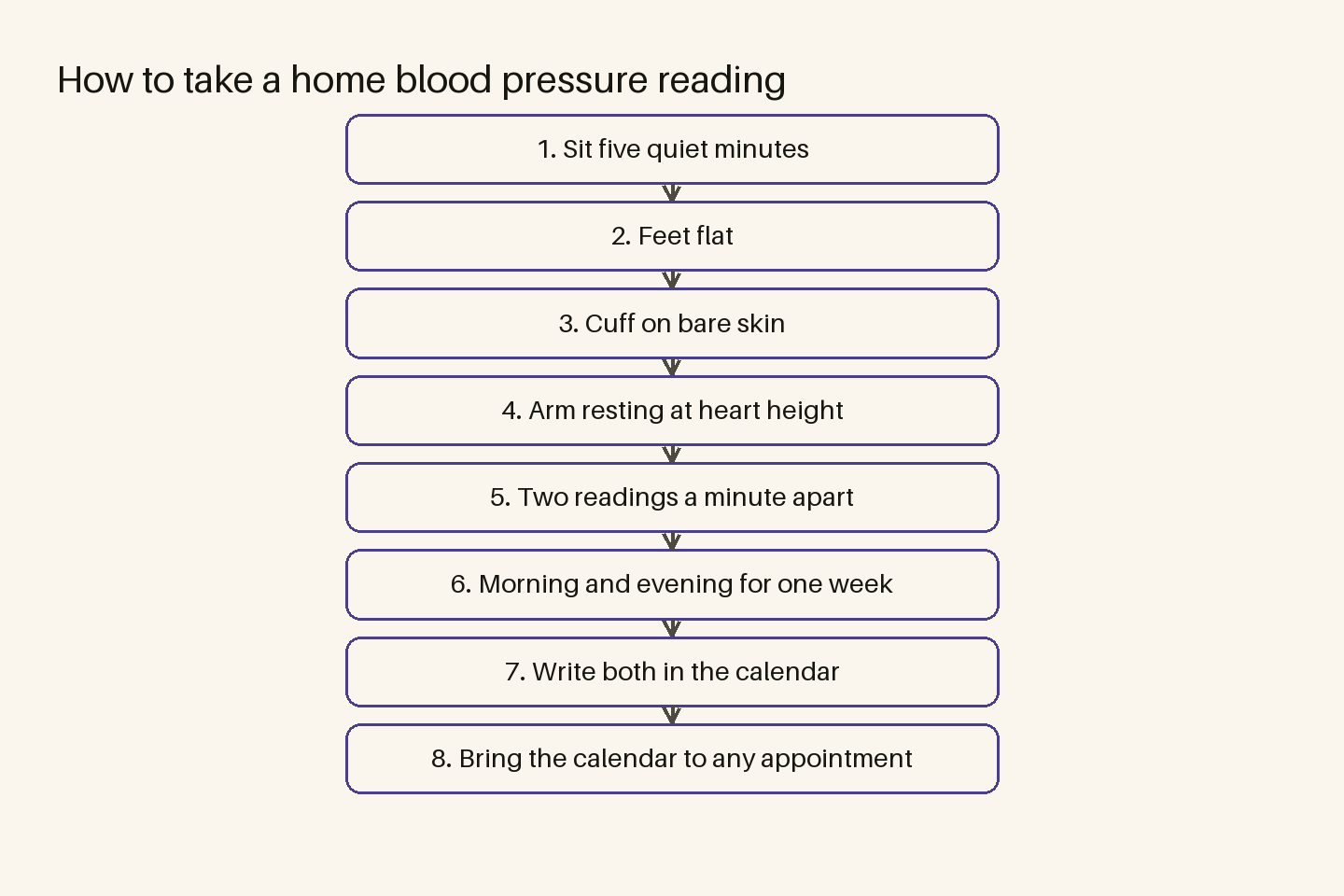
What I actually do, most weeks: sit five quiet minutes, feet flat; cuff on bare skin, arm resting at heart height; two readings a minute apart, morning and evening for one week; write both in the calendar; bring the calendar, not my memory, to any appointment; and mention the readings to the pharmacist before I mention them to anyone else, because she has the time to read a column of numbers.
So before you sit through another week of guessing, pull up and sit through the video now, then start your own column tomorrow morning.
The calendar on the wall still says October in Walt’s handwriting. He wrote “mum’s birthday” on the wrong Thursday and neither of us has fixed it. The house is sold, the birthday is not, and I keep the wrong Thursday anyway.